

Why Founders Fail at Financial Planning—and How to Fix It
Why founders fail at financial planning usually comes down to delayed visibility, unrealistic assumptions, and inconsistent financial routines—not a lack of intelligence. Founders often postpone finance until a cash shortage, fundraising process, tax deadline, or hiring decision makes it urgent. A practical financial planning system turns cash, burn, runway, and operating trade-offs into information the company can use before a crisis.
What is the short answer to why founders fail at financial planning?
Founders fail at financial planning when they treat finance as historical recordkeeping instead of an operating discipline. They may track revenue without tracking collections, maintain a model without updating it with actuals, or delegate finance without reviewing assumptions. The fix is a recurring system for cash forecasting, scenario planning, metric review, and timely professional advice.
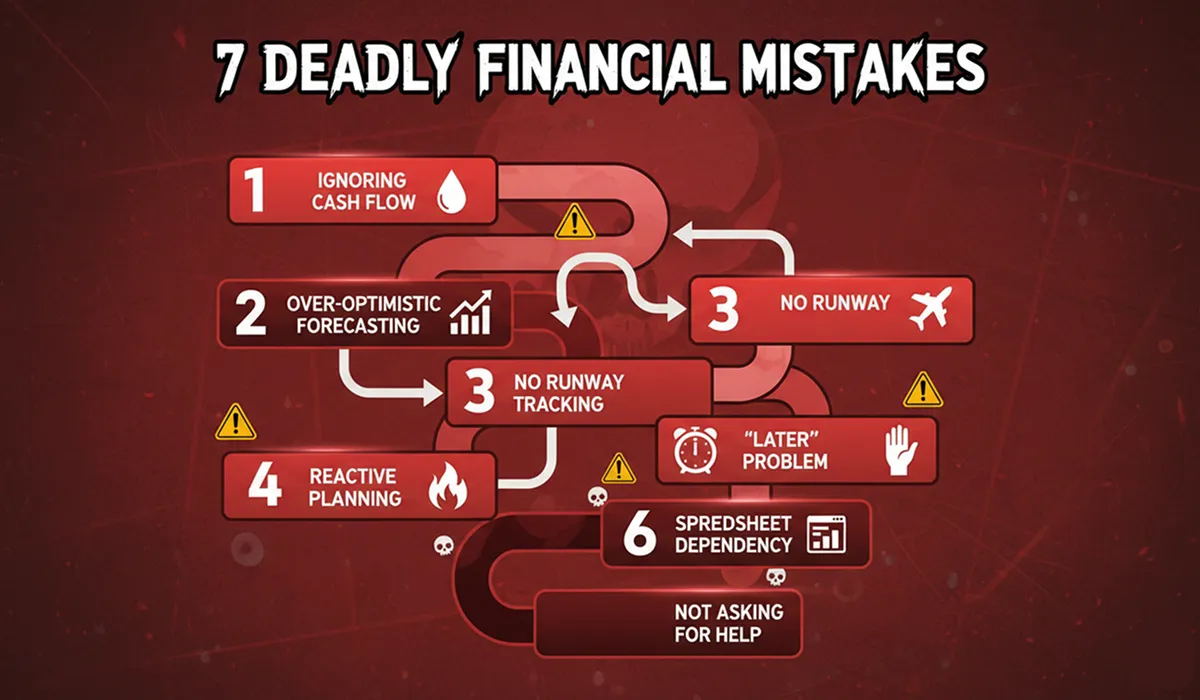
The seven most common mistakes are:
- Ignoring cash flow
- Forecasting with excessive optimism
- Tracking runway inaccurately
- Planning only after problems appear
- Treating finance as a later-stage responsibility
- Relying on fragile spreadsheets
- Avoiding expert help
Paul Graham describes a company as “default alive” when it can eventually become profitable without raising additional capital. His framework is useful because it connects runway to the company’s ability to reach sustainability, not merely to the date of the next fundraise. Read his explanation in “Default Alive or Default Dead?”.
A useful financial plan should answer one operational question clearly:
If fundraising stopped today, what would the company need to change to reach sustainability?
For a broader introduction, see Financial Operating System 101.
How serious is poor financial planning for startups?
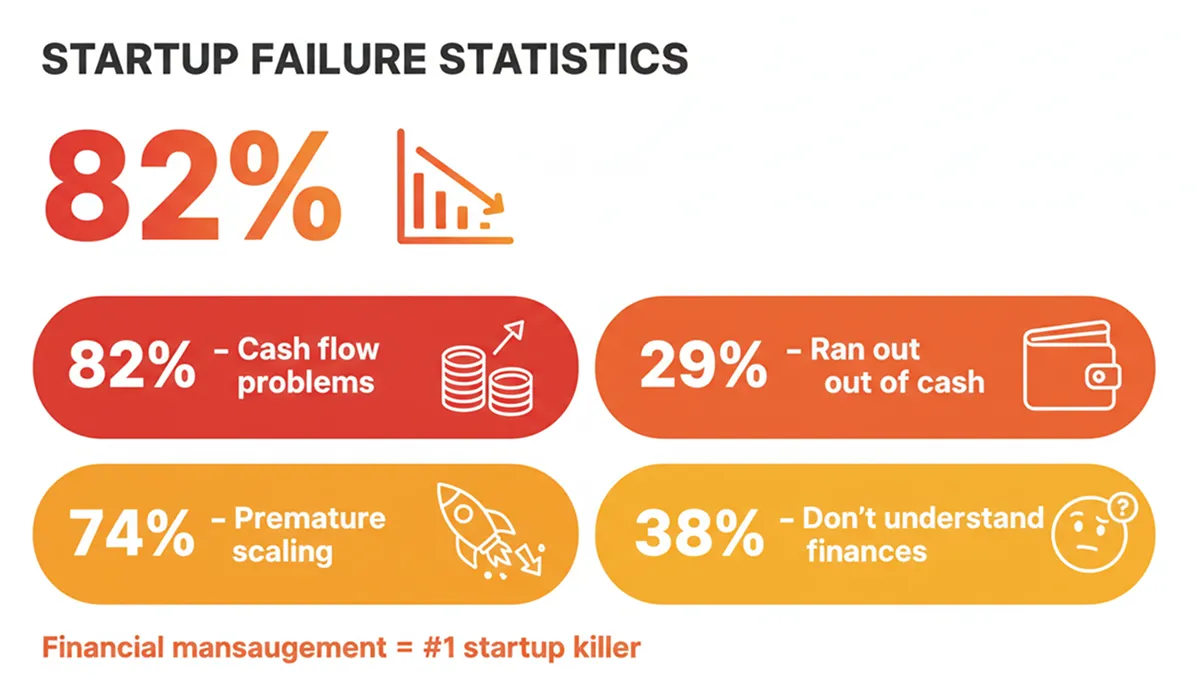
Poor financial planning is serious because cash problems are time-sensitive and difficult to reverse after they become urgent. A startup can report strong revenue growth and still miss payroll, tax, vendor, or debt obligations when customers pay later than expenses are due. The available research differs by sample and methodology, but cash constraints, weak unit economics, and premature scaling appear repeatedly in analyses of startup failure.
Several sources provide useful context:
- CB Insights’ analysis of failed venture-backed startups includes running out of cash among the leading contributors to failure, alongside poor product-market fit, business-model problems, and weak unit economics. See its startup failure analysis.
- The frequently cited U.S. Bank statistic that 82% of small businesses fail because of cash-flow problems should be treated as an attributed industry statistic, not a universal measure of startup failure.
- Startup Genome has associated premature scaling with startup failure, particularly when companies increase spending before validating demand and repeatable economics. Its research is available through the Global Startup Ecosystem Report.
- A company beginning a fundraise with three months of cash typically has fewer options than one beginning with nine to twelve months. The actual fundraising timeline varies with traction, market conditions, sector, and investor demand.
The practical conclusion is more important than any single percentage: cash visibility and disciplined spending reduce the number of irreversible decisions a founder must make under pressure.
Why do founders struggle with financial planning?
Founders struggle because product and sales work produce immediate feedback, while financial discipline often creates value by preventing problems. Early-stage companies may also lack historical data, finance training, or dedicated finance staff. These constraints make planning feel optional until a missed payment, unexpected tax bill, or delayed fundraise exposes the cost of operating without a system.
Is finance really a later-stage problem for an early-stage company?
Finance is not a later-stage problem because early decisions compound. A hire, annual software contract, debt commitment, or pricing change can affect cash for months. A pre-revenue founder does not need a complex FP&A department, but does need a current cash balance, realistic burn estimate, runway calculation, and written process for major spending decisions.
A risky timeline often looks like this:
- Months 1–6: “We are too early to worry about finance.”
- Months 7–12: “Revenue is growing, so the numbers must be fine.”
- Months 13–18: “We should organize the model now.”
- Months 19–24: “We have only a few months of cash left.”
The better approach is lightweight from day one and more sophisticated as transaction volume, headcount, and financing complexity increase.
Should a founder hire a CFO immediately?
Most founders do not need a full-time CFO on day one, but every company needs clear ownership of financial data and a regular review process. A bookkeeper can maintain records and reconciliations, an accountant can support tax and financial statements, and a fractional CFO can help with fundraising, complex revenue models, and strategic planning. Software improves visibility but does not replace accounting judgment or fiduciary responsibility.
What are the seven financial planning mistakes founders make?
The seven mistakes are failures of visibility and follow-through: confusing profit with cash, assuming the best case will happen, calculating runway inconsistently, reacting too late, postponing financial controls, overusing fragile spreadsheets, and refusing help. Each mistake is manageable when addressed early; the risk comes from allowing several to compound at once.
Why is ignoring cash flow a mistake?
Ignoring cash flow is dangerous because accounting profit and bank balance measure different things. Revenue may be recognized before a customer pays, while payroll, software, taxes, and vendors must be paid immediately. A founder watching only revenue or monthly profit can miss a cash gap that becomes urgent before the next financing opportunity.
Common warning signs include:
- Checking the bank balance irregularly
- Treating signed contracts as available cash
- Assuming profitability means liquidity
- Ignoring payment terms and collections
- Reviewing cash only at month-end
For example, a SaaS company might sign a $500,000 annual contract with net-60 payment terms and hire three engineers immediately. The contract may improve reported revenue, but the company still has to fund two months of payroll before receiving the customer’s cash.
Fix the problem by:
- Reviewing inflows and outflows weekly
- Separating booked revenue, invoiced revenue, and collected cash
- Modeling payment terms for major customers
- Including taxes, annual renewals, and one-time costs
- Testing delayed-payment scenarios
A cash forecast is useful only when it reflects expected payment timing, not merely signed deals.
Why is over-optimistic forecasting a mistake?
Over-optimistic forecasting turns a plan into a fundraising narrative rather than a decision tool. Founders commonly overestimate conversion, underestimate sales cycles, assume low churn, and delay cost increases in their models. The result is a forecast that looks encouraging but fails to show when hiring or spending must change.
A simple example:
Founder projection: $100,000 MRR by month 12
Actual result:      $15,000 MRR by month 12
Operating impact:   runway ends earlier than planned
The problem is not ambition. The problem is using an ambition case to make commitments.
Use three scenarios:
- Upside: faster sales, stronger conversion, and controlled costs
- Base: the most defensible outcome based on current evidence
- Downside: slower sales, higher churn, delayed collections, and required cost reductions
Make commitments against the base case. Then test whether the company survives the downside case. Update the forecast monthly with actual revenue, expenses, hiring, churn, and collections.
A dedicated financial modelling tool can make scenario comparisons easier, but the assumptions still require founder judgment.
Why is inaccurate runway tracking a mistake?
Inaccurate runway tracking gives founders a false sense of time. Runway is the estimated period until cash reaches zero at a defined burn rate, so it changes when cash, expenses, collections, hiring, or financing assumptions change. A calculation based on an old bank balance or incomplete commitments is not a reliable operating metric.
The basic formula is:
Runway in months = cash available ÷ average monthly net burn
For example, $600,000 in available cash and $75,000 in monthly net burn imply approximately eight months of runway. That estimate changes when the company hires, loses a customer, receives a large invoice, or increases spending.
Track at least:
- Cash available
- Gross burn
- Net burn
- Burn trend
- Committed future expenses
- Current runway
- Runway after planned hires
- Break-even timeline
Internal alerts at nine, six, and three months can create useful decision points. They are planning thresholds, not universal rules. Sequoia Capital’s “Adapting to Endure” memo also emphasized preserving sufficient capital during uncertain markets.
Why is reactive planning a mistake?
Reactive planning forces founders to make strategic decisions when their options are already limited. A delayed customer payment, unexpected tax bill, or failed fundraise can become a crisis if the team discovers it only after the cash balance falls. Proactive planning identifies risks while the company still has time to change hiring, pricing, collections, or spending.
Reactive planning sounds like:
- “We are running low on cash.”
- “This customer churned, so the plan no longer works.”
- “We did not realize this hire changed the runway.”
- “The fundraise is taking longer than expected.”
Proactive planning sounds like:
- “The downside case shows a cash gap in eight weeks.”
- “The planned hires reduce runway below our target.”
- “Collections are slower, so we are changing payment terms.”
- “We need to begin fundraising before the next milestone.”
A 13-week rolling cash forecast is a practical minimum for many startups. Review it weekly, compare projected cash with actual cash, and record the reasons for material variances.
Why is postponing financial processes a mistake?
Postponing financial processes makes later decisions more expensive because the company loses historical context. Without organized transaction data, founders cannot explain burn changes, customer profitability, hiring impact, or forecast variance. Investors also expect credible financial statements and a coherent explanation of how capital is being converted into milestones.
Start with a small operating system:
- Use a dedicated business bank account.
- Keep accounting records current.
- Categorize expenses consistently.
- Track revenue, collections, and churn separately.
- Review cash and forecast variance every week.
- Document approval rules for material expenses.
Retention deserves attention alongside acquisition. Bain & Company’s widely cited research, based on work with Frederick Reichheld, found that a 5% increase in customer retention can increase profits substantially, although the impact varies by industry and business model. The useful lesson is not to apply one percentage universally; it is to measure retention before assuming new growth will compensate for churn.
Why is relying on spreadsheets alone a mistake?
Spreadsheets are useful for simple models, but they become fragile when multiple people edit them, data arrives from several systems, or assumptions change frequently. A spreadsheet does not automatically provide clean source data, consistent definitions, auditability, or real-time alerts. The question is whether it remains reliable for the company’s complexity and decision speed.
Spreadsheets can work well when:
- The company is pre-revenue or has limited transaction history
- One person owns the model
- The business model is straightforward
- Assumptions are reviewed and documented
- The model is reconciled to accounting records
They become risky when:
- Multiple versions circulate
- Formulas depend on manual copy-and-paste
- Actuals are imported inconsistently
- Hiring and scenario changes happen frequently
- The model supports payroll or other cash-critical decisions
Purpose-built tools can automate data collection, scenario analysis, and alerts. They should complement—not replace—accounting software and professional review.
See Uniflow vs. Spreadsheets and AI Cash Flow Forecasting for Startups.
Why is refusing financial help a mistake?
Refusing help creates avoidable risk because founders rarely have unlimited time and finance expertise. Asking for help does not mean giving up control. It means assigning bookkeeping, tax work, model review, or fundraising preparation to people with the relevant experience while the founder remains accountable for decisions.
Potential support includes:
- Bookkeeper: transaction categorization and reconciliations
- Accountant: tax compliance and financial statements
- Fractional CFO: forecasting, fundraising, and strategic planning
- Financial operating system: recurring visibility and workflow
- Investor or advisor: financing context and operating benchmarks
The appropriate combination depends on company size, transaction complexity, financing stage, and the founder’s capabilities.
How do financial mistakes compound over time?
Financial mistakes compound because each inaccurate assumption affects future decisions. An underestimated burn rate can lead to an unnecessary hire; that hire increases monthly costs; the higher costs shorten runway; and the shortened runway forces an emergency fundraise. Early correction is usually cheaper than late correction because the company still has time and options.
What happens during the first three months?
During the first three months, the main risk is incomplete visibility rather than immediate insolvency. Founders may have no consistent chart of accounts, cash forecast, or agreement about which metrics matter. Spending may still be low, but the absence of a baseline makes later changes difficult to interpret.
Establish the basics immediately:
- Open and use a dedicated business account
- Record every expense
- Define gross burn and net burn
- List committed obligations
- Set a weekly finance review
What happens during months four through six?
Between months four and six, optimistic assumptions often become operating commitments. Founders may hire ahead of validated demand, sign expensive tools, or increase marketing based on early signals. If the model is not updated with actual conversion, churn, and collections, the company continues spending according to a plan that no longer reflects reality.
At this stage, compare the forecast with actual performance and explain material variances. A forecast is not a scorecard for whether the founder was right; it is a mechanism for deciding what to do next.
What happens during months seven through twelve?
By months seven through twelve, the consequences are more visible. Burn may be materially higher than planned, runway may be shorter than reported, and a fundraise may take longer than expected. The company may still recover, but recovery now requires coordinated changes to hiring, pricing, sales, collections, and spending.
Beginning fundraising only after the company reaches a critical cash threshold can reduce negotiating leverage. Fundraising timing should account for the company’s runway, expected process length, milestones, and downside scenario.
How do proactive and reactive founders reach different outcomes?
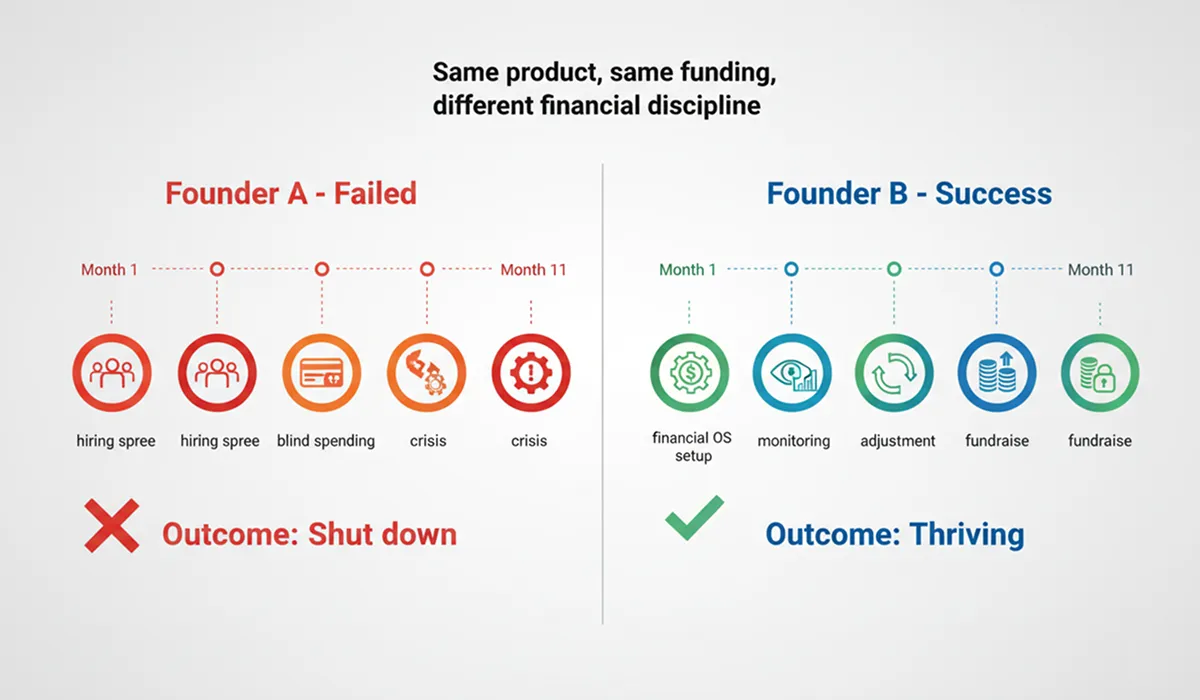
Proactive and reactive founders may start with similar products and funding yet produce different outcomes because they make decisions at different points in the cash cycle. The proactive founder uses financial data to adjust before a problem becomes urgent. The reactive founder waits for the bank balance or a failed milestone to force action.
What happened to the reactive founder?
The reactive founder raised $500,000, hired aggressively after early growth, and did not update the burn forecast. By month nine, the company discovered that only two months of runway remained. The emergency fundraise began from a weak negotiating position, and the company ran out of cash before securing new capital.
This is a representative scenario, not a prediction. Actual outcomes depend on revenue, expenses, financing conditions, and the founder’s ability to reduce costs quickly.
What happened to the proactive founder?
The proactive founder used the same initial capital to establish a weekly cash review, model planned hires, and monitor downside scenarios. When the forecast showed that hiring would reduce runway below the company’s target, the founder delayed the hires and began fundraising earlier. The company preserved options and negotiated from a stronger position.
This approach does not guarantee success. Its advantage is better timing, clearer assumptions, and earlier intervention.
Which financial planning approach is right for a startup?
The right approach depends on company complexity and stage. Spreadsheets may be sufficient for a pre-revenue company with few transactions, while a growing startup may need integrated accounting, forecasting, scenario planning, and workflow. A fractional CFO becomes more valuable as judgment and transaction complexity increase; software becomes more valuable when recurring visibility and execution are the bottleneck.
How do the main approaches compare?
| Approach | Best fit | Strengths | Limitations | Typical cost or pricing |
|---|---|---|---|---|
| Uniflow | Startups that need recurring cash visibility, forecasting, and financial planning | Automated financial workflows, cash-flow visibility, scenario planning, and AI-assisted insights | Does not replace accounting, tax advice, or strategic CFO judgment | Free for early-stage startups, according to the original product positioning; verify current plan terms |
| Spreadsheets | Pre-revenue companies with simple finances and limited data | Low software cost, flexible, and familiar | Manual maintenance, version-control issues, and limited automation | $0 in software; founder time is the main cost |
| Bookkeeper | Companies that need accurate transaction records and reconciliations | Maintains books and supports tax preparation | Usually backward-looking; does not provide full strategic forecasting | Quote-only; varies by transaction volume and service scope |
| Fractional CFO | Companies preparing for fundraising or managing complex financial decisions | Human judgment, fundraising support, and strategic analysis | Higher cost and limited availability compared with an internal executive | Quote-only; the original post estimates approximately $1,000–$3,000+ per month |
| Runway or Finmark | Startups evaluating dedicated planning and forecasting software | Planning and reporting workflows designed for startups | Pricing, integrations, and feature depth vary by provider | Quote or plan-dependent; verify current pricing directly with each provider |
No tool can correct poor assumptions automatically. The founder still needs to define goals, approve spending, challenge the forecast, and act on warnings.
What should founders use at each stage?
A practical stage-based approach is to start with accurate books and a simple forecast, then add automation and expert support as complexity increases. These cost ranges are directional rather than universal: software plans, bookkeeping scope, geography, and CFO experience can materially change the total.
| Stage | Recommended approach | Directional monthly cost |
|---|---|---|
| Pre-seed | Accounting basics, cash forecast, and a lightweight financial operating system | $0–$500 |
| Seed | Financial operating system plus bookkeeping and occasional CFO review | $500–$3,000+ |
| Series A | Integrated planning, reliable accounting, and fractional or internal finance leadership | $2,500–$10,000+ |
| Series B and beyond | Finance team, formal controls, board reporting, and full-time leadership | $10,000+ |
The best stack is usually complementary: accounting software for records, a planning system for forward-looking decisions, and experienced professionals for judgment-heavy work.
How can a founder fix financial planning in the next 30 days?
A 30-day reset should establish reliable data, a current runway calculation, scenario planning, and a recurring review cadence. Do not try to build a perfect finance department first. Reconcile cash, document assumptions, and create a process that the founder or finance owner can maintain every week.
What should happen during week one?
Week one is about creating a trustworthy baseline. Connect financial accounts, reconcile the current cash position, classify recent transactions, and separate recurring expenses from one-time costs. Then calculate runway using current burn and the expected impact of committed hires, contracts, and payment delays.
Use this checklist:
- Connect business bank and payment accounts
- Reconcile cash to accounting records
- Categorize recent transactions
- Calculate gross and net burn
- Calculate runway using current cash and burn
- List committed expenses and planned hires
- Schedule a weekly cash and runway review
A financial operating system such as Uniflow can centralize this workflow, but the baseline should still be checked against source records.
What should happen during weeks two and three?
Weeks two and three should turn the baseline into a decision model. Build base, upside, and downside scenarios for revenue, collections, hiring, and operating costs. Identify which expenses are fixed, variable, or discretionary. Define the actions the company will take if runway crosses six months or another internal threshold.
Use headcount planning software to model start dates, compensation, taxes, benefits, and the effect of each hire on runway. Include delayed hiring and contractor alternatives where relevant.
What should happen during week four?
Week four is about governance and repeatability. Create a monthly forecast update, weekly cash review, approval policy for material spending, and concise investor reporting package. Assign ownership for each data source and record the reason for significant forecast changes.
By the end of the month, the founder should be able to answer:
- How much cash is available today?
- What is the current net burn?
- How many months of runway remain?
- Which assumptions drive the forecast?
- What happens if sales are delayed by three months?
- Which hires or expenses can be delayed?
- When must fundraising begin?
How often should founders review financial metrics?
Founders should review unusual transactions and alerts as they occur, cash and runway weekly, forecasts monthly, and strategic plans quarterly. The exact cadence can change with company stage, but the discipline should not disappear during strong growth. A short, consistent review is more valuable than an elaborate model that no one updates.
Daily or as needed:
- Review cash alerts
- Approve material expenses
- Monitor unusual transactions
Weekly:
- Review cash inflows and outflows
- Update runway and burn trend
- Compare forecast with actuals
- Check collections and upcoming obligations
Monthly:
- Update the forecast
- Review revenue, churn, gross margin, and operating costs
- Prepare management or investor reporting
- Revisit hiring assumptions
Quarterly:
- Review strategic scenarios
- Prepare board materials
- Reassess fundraising timing
- Evaluate controls and reporting quality
Which tools and resources help founders manage finance?
The essential finance stack does not need to be large. It should produce accurate books, timely cash visibility, dependable revenue and expense data, and a forecast that supports decisions. Accounting software, banking data, payment processors, a planning tool, and human review can work together when ownership and definitions are clear.
What tools should an early-stage company consider?
A typical stack may include:
- Financial planning and operating system: Uniflow or another planning platform
- Accounting software: QuickBooks, Xero, or a comparable system
- Business banking: An account with reliable reporting and integrations
- Payment processing: Stripe, PayPal, or the processor appropriate to the business
- Payroll and expense management: Tools that export clean data to accounting
- Reporting layer: A consistent monthly package for management and investors
Integrations reduce manual work, but founders should still reconcile data and understand how each tool defines revenue, cash, expenses, and liabilities.
Which resources improve financial literacy?
Useful resources include:
- Books: Financial Intelligence by Karen Berman and Joe Knight; Venture Deals by Brad Feld and Jason Mendelson; The Lean Startup by Eric Ries
- Programs: Y Combinator Startup School and other founder education programs
- Communities: Indie Hackers, SaaStr, local founder groups, and investor office hours
- Guides: Financial Operating System 101 and Financial OS vs. Traditional FP&A
Use benchmarks as context, not as a substitute for company-specific analysis.
When should a founder hire professional financial help?
A founder should seek professional help when financial complexity or risk exceeds the team’s ability to manage it reliably. Common triggers include a major fundraise, rapid hiring, multiple entities, complex revenue recognition, debt, tax exposure, or investor reporting that is difficult to prepare internally.
Consider a:
- Bookkeeper: when transaction volume and reconciliations consume founder time
- Accountant: when tax filings, financial statements, or compliance require expertise
- Fractional CFO: when preparing for a significant raise, managing complex unit economics, or planning cash strategically
- Full-time CFO: when the company has a substantial finance function, complex reporting needs, or sustained scale
Quoted costs vary widely. Treat any range as a budgeting starting point, not a market guarantee.
How can financial discipline become a competitive advantage?
Financial discipline becomes a competitive advantage when it improves the speed and quality of operating decisions. A founder who knows the cash impact of a hire, pricing change, or delayed payment can act before competitors operating on intuition. Discipline also improves credibility with employees, lenders, investors, customers, and vendors.
What mindset should founders replace?
Replace:
- “Finance is boring.”
- “I will deal with it after the next raise.”
- “Revenue growth means we are healthy.”
- “The spreadsheet is probably current.”
- “Asking for help shows weakness.”
With:
- “Cash is an operating constraint.”
- “Every major decision has a financial consequence.”
- “Forecasts are assumptions that must be tested.”
- “The model is useful only when it matches actuals.”
- “Expert support improves accountability.”
The goal is not to become a professional accountant. The goal is to understand the financial signals that determine what the company can safely do next.
What should founders remember about financial planning?
Founders do not usually fail at financial planning because they lack ambition. They fail because they delay visibility, confuse growth with liquidity, and allow an outdated plan to guide current decisions. A simple weekly system—accurate cash data, realistic scenarios, runway tracking, and timely advice—can prevent many avoidable surprises.
Start with four habits:
- Reconcile cash and financial records.
- Track runway using a clearly defined burn rate.
- Update the forecast with actual performance.
- Review major decisions through a cash and scenario lens.
Uniflow is one option for founders and finance leaders who want an AI-assisted financial operating system for cash visibility, forecasting, and planning. It can help centralize recurring financial workflows and scenario analysis, but it does not replace accounting, tax advice, or CFO judgment. Review the current product scope and plan terms before adopting any software.
Explore Uniflow’s financial operating system.
What are the most common questions about founder financial planning?
The answers below provide practical starting points, but they are not a substitute for accounting, tax, legal, or investment advice tailored to your company.
Does a pre-revenue startup need financial planning?
Yes. Pre-revenue companies often have the least margin for error because runway depends almost entirely on available capital and spending. A pre-revenue founder should track cash, monthly burn, committed expenses, hiring plans, and the milestones required before the next financing or revenue event.
How much time should a founder spend on financial planning?
Most founders can begin with 30 to 60 minutes per week for a structured review, plus additional time during fundraising, hiring, or major planning cycles. The time requirement increases when records are disorganized. Automation can reduce manual work, but it cannot eliminate the need to review assumptions and make decisions.
What is the most important financial metric for a startup?
Runway is usually the most urgent metric because it measures how long the company can continue under a defined burn rate. It should be reviewed alongside net burn, revenue growth, gross margin, collections, churn, and unit economics. Runway alone cannot show whether the business model is becoming healthier.
When should a startup hire a CFO?
Hire a CFO or fractional CFO when the company faces financial complexity that exceeds the founder’s or bookkeeper’s capabilities. Common triggers include a major fundraise, multiple entities, complex revenue recognition, rapid headcount growth, debt, board reporting, or difficult cash and unit-economic decisions.
Can a financial planning system replace a CFO?
No. A financial planning system can automate data collection, reporting, forecasting, and alerts, but it cannot replace strategic judgment, accounting oversight, tax advice, fundraising relationships, or fiduciary responsibility. Software is most effective when it gives founders and finance professionals a shared, current view of the business.
What if the company has already made these mistakes?
Start with the facts: reconcile cash, calculate current burn, list committed obligations, and identify true runway. Then freeze avoidable spending, update the base and downside forecasts, and communicate early with investors, employees, lenders, and vendors where appropriate. Earlier action generally creates more options than emergency action.
Which financial planning resources should founders read next?
Continue with:
- Financial Operating System 101: Complete Guide
- How AI Improves Financial Forecasting
- Uniflow vs. Spreadsheets Comparison
- Financial OS vs. Traditional FP&A
- Operational Headcount and Payroll Planning
- Strategic Workforce Planning Platform
Keywords: why founders fail at financial planning, startup financial mistakes, financial planning for founders, cash flow management for startups, runway tracking, burn rate calculator, founder financial education, startup finance
About the Author: Michael Stan is an accountant, financial advisor, and founder of Uniflow. He has spent more than a decade advising early-stage companies and building financial systems for startup teams.