

Financial Operating System for Startups: A Practical Guide Beyond Spreadsheets
A financial operating system for startups connects cash flow, forecasting, runway, reporting, and scenario planning in one repeatable workflow. It helps solo founders and CFOs answer urgent questions—how much cash is available, how quickly it is being spent, and whether the company can afford its next hire—without rebuilding a fragile spreadsheet every month.
A financial operating system does not replace accounting, bookkeeping, or CFO judgment. It adds a forward-looking planning layer to the historical financial record, helping a startup turn financial data into operating decisions.
What is a financial operating system for startups?
A financial operating system is software that connects financial data, business assumptions, and planning workflows to produce current financial insight. Accounting software records what happened. A financial OS combines those records with assumptions about revenue, hiring, expenses, and fundraising to show what may happen next.
Most financial operating systems connect:
- Bank and credit-card accounts
- Accounting software
- Payment processors such as Stripe
- Payroll and expense systems
- Revenue and headcount assumptions
- Forecasts and scenario models
- Management and investor reporting
The result is a repeatable financial workflow rather than a collection of disconnected files.
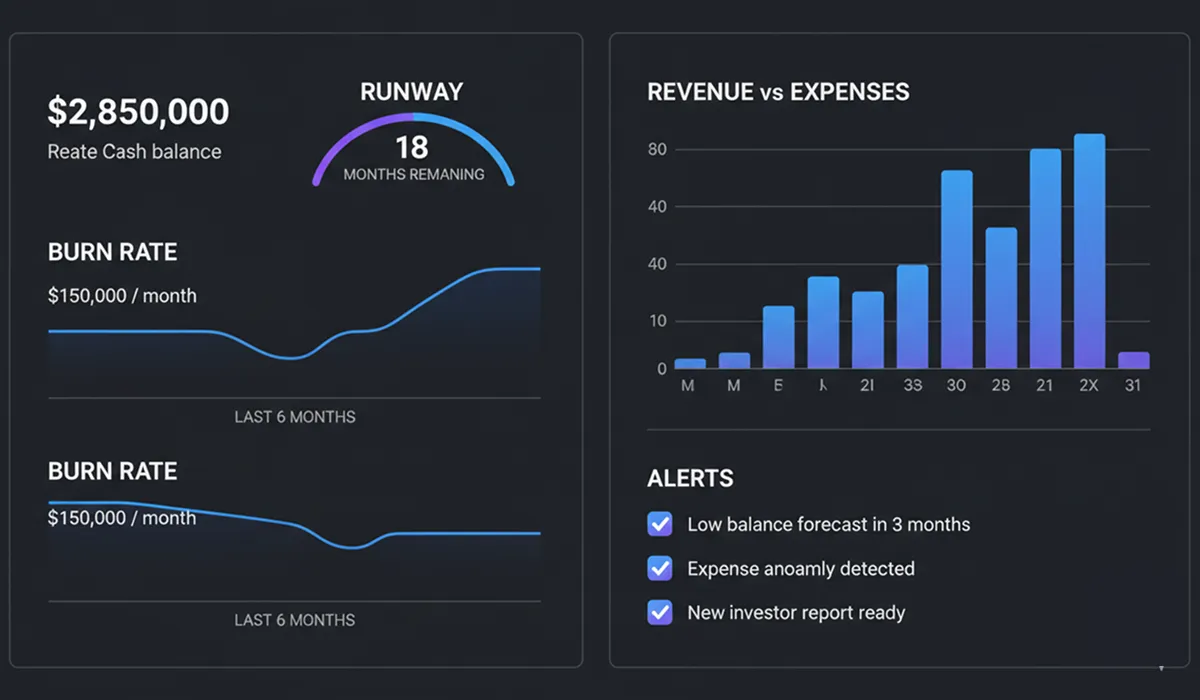
How does a financial operating system work?
A financial operating system imports or synchronizes historical financial information, organizes it into useful categories, and applies operating assumptions to build forecasts. The founder or finance team then reviews actual performance against the forecast, investigates material changes, and updates the plan.
A typical workflow is:
- Connect data: Import bank, card, accounting, payroll, and payment information.
- Classify activity: Separate revenue, payroll, contractors, software, marketing, and other costs.
- Define metrics: Establish consistent definitions for cash, gross burn, net burn, and runway.
- Build a baseline: Forecast expected revenue, expenses, cash receipts, and payments.
- Model decisions: Test hiring, pricing, fundraising, or cost-reduction scenarios.
- Review variances: Compare actual results with the plan and document significant changes.
- Share reports: Give investors, advisors, and the team a consistent view of performance.
The system is valuable because these steps can become a recurring operating rhythm instead of a manual monthly project.
What does a financial operating system manage?
A financial operating system typically manages cash visibility, forecasting, burn-rate analysis, runway monitoring, scenario planning, and financial reporting. The most useful platforms connect these functions so that a change in one assumption—such as a new hire—flows through expenses, cash burn, runway, and reporting.
| Component | What it does | Why it matters to a startup |
|---|---|---|
| Cash tracking | Consolidates balances and transactions | Shows current liquidity |
| Revenue forecasting | Projects recurring, one-time, or pipeline revenue | Supports hiring and growth planning |
| Expense planning | Tracks fixed, variable, and planned costs | Makes spending decisions explicit |
| Burn-rate analysis | Measures how quickly cash is being consumed | Reveals whether spending is accelerating |
| Runway monitoring | Estimates how long cash will last | Creates time to reduce costs or raise capital |
| Scenario modeling | Tests alternative assumptions | Quantifies the effect of major decisions |
| Reporting | Produces consistent financial summaries | Improves investor and management communication |
For investor-ready models, founders can also use Uniflow’s free financial modelling tool.
Why are startups moving beyond spreadsheets?
Startups move beyond spreadsheets when financial data becomes too interconnected, frequently changing, or important to manage through manual updates. Spreadsheets remain useful for custom analysis, but they become harder to control when a company has multiple accounts, employees, revenue streams, entities, or stakeholders.
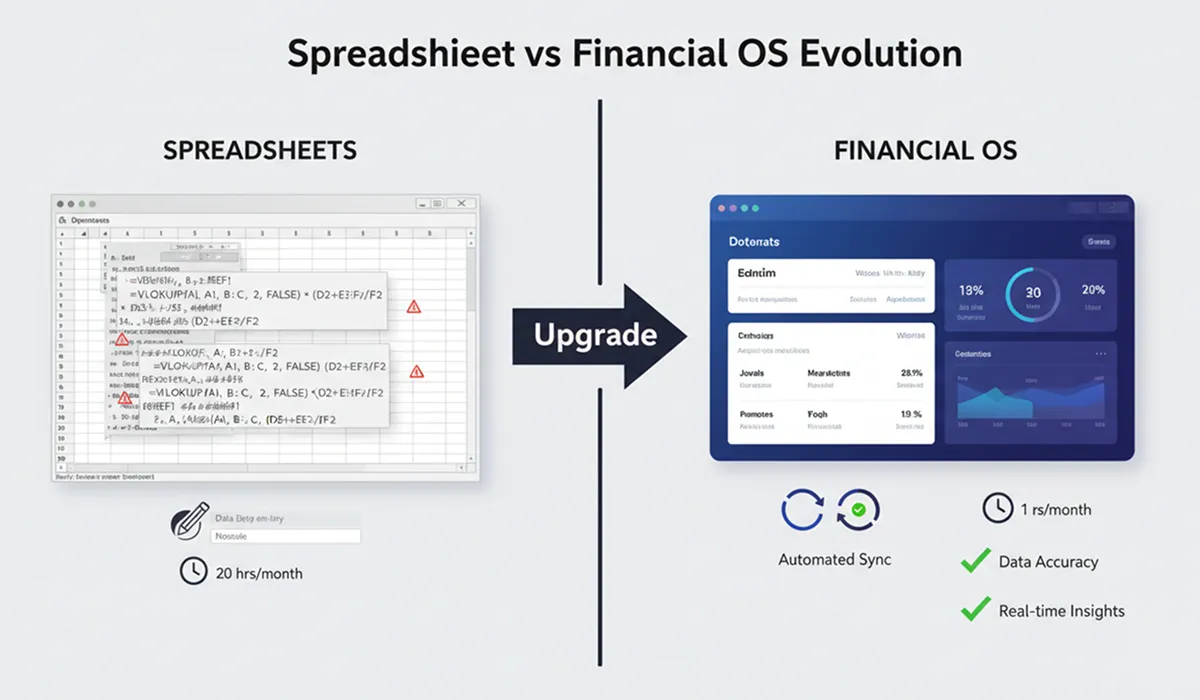
Three pressures usually drive the change:
- More data: Banking, payments, payroll, expenses, and subscriptions often live in separate systems.
- Faster decisions: Founders may need to decide on hiring or spending before the monthly close.
- Higher reporting expectations: Investors and boards expect coherent metrics, assumptions, and explanations.
Cash management is particularly important because running out of cash or failing to raise new capital has been identified as a leading reason startups fail. CB Insights lists this among the most common startup failure factors. Better visibility cannot guarantee success, but it can give a company more time to respond.
“The biggest shift is from reactive to proactive financial management. Founders need to know about problems before they become crises.”
— Marcus Rodriguez, Fractional CFO
Why do spreadsheets become risky as a startup grows?
Spreadsheets become risky when they rely on manual imports, duplicated formulas, undocumented assumptions, unclear ownership, or multiple competing versions. They are not inherently unreliable; their flexibility is valuable. The risk comes from using a flexible analysis tool as the company’s only source of financial truth without adequate controls.
Spreadsheet risk has been documented in research by Raymond Panko, whose Spreadsheet Research examines errors in operational and financial spreadsheets. The risk varies by model complexity, review process, and user discipline, so no single error rate applies to every workbook. The practical lesson is that financial models need testing, version control, and review.
| Risk | What typically happens | Startup consequence |
|---|---|---|
| Manual data entry | Bank and payment data are copied periodically | Forecasts rely on stale or incomplete information |
| Formula changes | A row or formula is edited without review | Key metrics may be misstated |
| Version sprawl | Several files become “the latest” model | Teams use different assumptions |
| Limited audit trail | Changes are not documented consistently | Errors take longer to investigate |
| Slow scenario work | Each scenario requires manual rebuilding | Decisions are delayed or avoided |
| Fragile scaling | New employees, products, or entities require workarounds | The model becomes harder to maintain |
A spreadsheet can remain appropriate for a very small company with simple finances and strong review practices. The issue is process control—not whether the file is called Excel or Google Sheets.
What benefits does a financial operating system provide?
A financial operating system reduces repetitive work, makes assumptions visible, and gives founders a faster way to compare financial outcomes. It can synchronize data, standardize calculations, flag unusual movements, and connect operating decisions to cash and runway.
The main benefits include:
- Less manual reconciliation: Connected data reduces repetitive copying and pasting.
- Faster visibility: Founders can review balances and trends more frequently.
- Consistent assumptions: Revenue, headcount, and expense inputs are easier to review.
- Faster scenarios: Hiring, pricing, and fundraising cases can be compared quickly.
- Better communication: Investors, advisors, and employees can use shared metrics.
- Earlier warnings: Runway thresholds and variance alerts create time to act.
Automation is not a substitute for review. An incorrect category or unrealistic assumption can be propagated faster by software than by a spreadsheet. A reliable workflow still requires reconciliations, documented definitions, and human judgment.
When should a startup adopt a financial operating system?
A startup should adopt a financial operating system when the value of timely financial visibility exceeds the cost of setup and maintenance. This may happen after the first meaningful revenue or fundraising event, but transaction complexity and decision frequency are better indicators than funding stage alone.
Adoption often makes sense when a company has:
- Multiple bank accounts, cards, entities, or revenue streams
- Employees or a growing contractor base
- Recurring revenue and meaningful payment timing
- A planned hiring decision within the next three months
- Upcoming fundraising or investor reporting
- Regular changes to its forecast
- Several people relying on the same financial metrics
- More finance work than the founder can consistently maintain
The goal is not to adopt the most sophisticated platform available. It is to establish a trusted source for recurring financial decisions.
When are spreadsheets still sufficient?
Spreadsheets may be sufficient when a startup has few transactions, no employees, limited historical data, and a founder who can maintain the model consistently. A full financial operating system may be unnecessary while a company is still testing an idea and its financial decisions are unlikely to change materially in the next several weeks.
A spreadsheet may be reasonable when the business is:
- Pre-revenue with limited financial activity
- Operating as a simple side project
- Managing one bank account and a few recurring expenses
- Not yet employing staff or contractors
- Using clearly documented formulas and assumptions
- Reviewed regularly by someone financially capable
Even at this stage, establish consistent categories, a cash reconciliation routine, and a basic runway calculation. Good data hygiene is easier to maintain than to reconstruct.
What signs indicate that a startup needs a financial OS?
The clearest signs are repeated manual work, uncertainty about cash, and decisions that depend on several linked assumptions. If a founder cannot answer basic financial questions quickly—or must open several portals and files to do so—the current process is creating operational risk.
Consider adopting a financial OS if you:
- Spend several hours each week maintaining financial files
- Cannot answer how many months of runway remain with confidence
- Need to combine data from banking, accounting, payroll, and payments
- Are preparing for fundraising or due diligence
- Need to compare hiring, pricing, or growth scenarios
- Have found reporting inconsistencies or missed deadlines
- Need current information before the monthly close
What financial setup fits each startup stage?
The right financial setup depends on transaction complexity, reporting requirements, and decision volume—not only on how much capital a company has raised. An early-stage business may use bookkeeping support and a financial OS, while a later-stage company may add stronger controls, board reporting, and dedicated finance leadership.
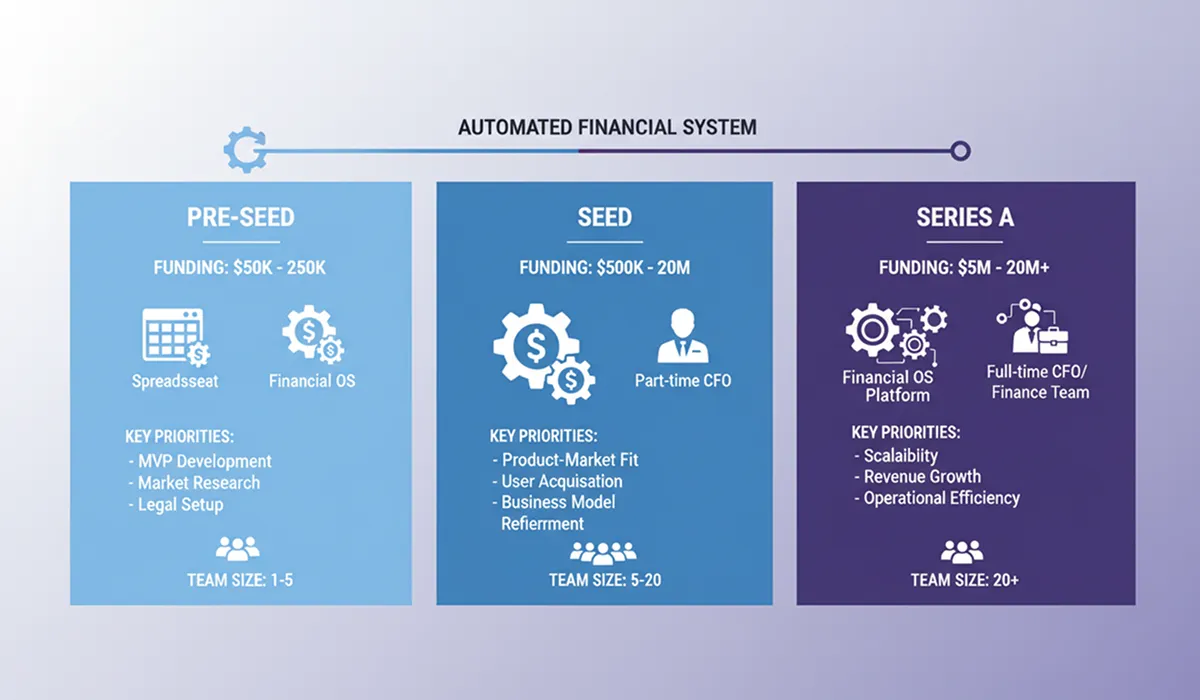
| Funding stage | Common financial priority | Practical setup |
|---|---|---|
| Pre-seed | Preserve cash and understand burn | Bookkeeping process, cash tracking, and a basic forecast |
| Seed | Prove unit economics and plan hiring | Financial OS, monthly close, scenario planning, and advisory support |
| Series A | Improve reporting and prepare for diligence | Financial OS, stronger controls, board reporting, and finance leadership |
| Series B and beyond | Scale planning, controls, and capital strategy | Dedicated finance team, CFO leadership, and integrated planning systems |
Funding labels are only a guide. A bootstrapped SaaS company with recurring revenue may need forecasting earlier than a pre-revenue company with very little activity.
How does a financial operating system compare with alternatives?
A financial operating system is strongest when a startup needs recurring visibility, forward-looking planning, and repeatable scenario analysis. It does not make spreadsheets, bookkeeping, or CFO advice obsolete. Each option serves a different purpose, and many startups use several of them together.
| Option | Best for | Strengths | Limitations | Pricing information |
|---|---|---|---|---|
| Uniflow | Early-stage founders who want connected planning and runway visibility | AI-powered financial planning, cash-flow visibility, scenario analysis, and a free early-stage option | Does not replace bookkeeping or strategic CFO judgment | Free early-stage option is stated in the original product description; verify current paid-plan pricing |
| Spreadsheets | Simple businesses and custom one-off analysis | Flexible, familiar, and inexpensive to start | Manual maintenance, version risk, and limited automation | May be included with an existing office subscription; incremental cost varies |
| Bookkeeper | Accurate historical records and transaction categorization | Reconciliations, tax preparation, and clean books | Usually backward-looking; may not provide strategic forecasting | Quote-only; varies by transaction volume and scope |
| Fractional CFO | Strategic advice, fundraising, and complex planning | Judgment, financial strategy, and investor experience | Limited availability and higher cost than software | Quote-only; varies by hours, scope, and advisor |
| Runway | Venture-backed companies focused on visual planning | Forecasting and scenario-planning orientation | Fit and integrations vary by company and plan | Quote-only or plan-dependent; verify current pricing |
| Pilot | Companies seeking bookkeeping and finance services | Service-led bookkeeping and financial support | May be more than a very early solo founder needs | Quote-only or plan-dependent; verify current pricing |
| Finmark | Companies prioritizing financial modeling and scenarios | Planning and modeling focus | Product availability, integrations, and plan structure should be confirmed | Unverified; check the current provider information |
How does a financial OS compare with spreadsheets?
A financial OS is generally better for recurring data synchronization, runway monitoring, alerts, and repeatable scenarios. A spreadsheet is generally better for unrestricted custom analysis and temporary calculations. Many founders should use both: the financial OS for operating visibility and spreadsheets for specialized analysis that does not need to become a recurring process.
Use spreadsheets when:
- The analysis is temporary or highly bespoke
- The business has very few transactions
- A finance-capable person reviews the model
- Version control and assumptions are documented
Use a financial OS when:
- Data must be refreshed regularly
- Several people rely on the same metrics
- Cash and runway decisions are frequent
- Scenarios need to be updated quickly
- The founder needs alerts rather than another monthly task
Read Uniflow vs. spreadsheets: why startups are making the switch for a detailed comparison.
How does a financial OS compare with a bookkeeper?
A bookkeeper maintains accurate historical records, while a financial OS organizes and interprets financial information for planning. These functions are complementary. A forecast built on unreconciled transactions may be misleading, while clean books alone do not show whether the company can afford a new hire.
A practical division of responsibility is:
- Bookkeeper: Reconciliations, categorization, accounts payable, month-end close, and tax support.
- Financial OS: Cash visibility, assumptions, forecasts, scenarios, and management reporting.
- Founder or CFO: Decisions, priorities, controls, and interpretation.
How does a financial OS compare with a fractional CFO?
A fractional CFO provides judgment, context, and strategic accountability. A financial OS provides systems, data access, repeatable calculations, and daily visibility. A CFO can decide whether a forecast assumption is realistic; software can show the consequences of that assumption across cash, runway, and hiring plans.
A fractional CFO may be appropriate when a startup is:
- Preparing for a financing round
- Building board reporting
- Managing complex fundraising or debt
- Evaluating pricing and unit economics
- Expanding into new entities or countries
- Designing finance controls or hiring a finance team
For many startups, the practical combination is a financial OS for execution, a bookkeeper for accurate records, and periodic CFO support for strategic decisions.
What does a financial operating system cost?
Financial OS pricing varies by provider, data volume, integrations, support, and service level. Some products offer free or low-cost early-stage plans, while others use quote-based pricing. Compare the full cost—including implementation, bookkeeping, advisory support, and founder time—rather than comparing software subscriptions alone.
Before choosing a platform, confirm:
- Whether a free plan is available to your company
- Which bank, accounting, payroll, and payment integrations are included
- Whether forecasts and scenarios are limited by plan
- Data export and ownership terms
- User permissions and audit history
- Support response times
- Security documentation and subprocessors
A more expensive platform is not automatically better for a small startup. The right question is whether the system improves decision quality and saves enough time to justify its cost.
Which features should founders look for?
The most important features are dependable data connections, transparent calculations, practical forecasting, scenario modeling, and exportable reporting. AI can reduce repetitive work, but it should explain its inputs and allow founders to review or override assumptions.
What are the essential financial OS features?
A useful financial operating system should provide the following capabilities:
-
Automatic data synchronization
- Bank and credit-card connections
- Payment-processor integrations
- Accounting and payroll connections
- Refresh status and error handling
-
Cash-flow forecasting
- Current cash position
- Expected receipts and payments
- Recurring and one-time transactions
- Actual-versus-forecast comparisons
-
Burn-rate and runway tracking
- Clear gross and net burn definitions
- Current and projected runway
- Adjustable cash and spending assumptions
- Alerts for meaningful changes
-
Scenario modeling
- Base, upside, and downside cases
- Hiring and compensation changes
- Pricing and conversion assumptions
- Fundraising timing and amount
-
Reporting
- Monthly management reports
- Investor and board-ready summaries
- Metric definitions and calculation logic
- Export options
-
Controls and permissions
- Read-only connections where appropriate
- User roles and access controls
- Data history and change tracking
- Reconciliation or review workflows
Learn more in how AI improves financial forecasting for startups.
Which features are useful but not essential?
Mobile access, Slack or email alerts, benchmarking, team comments, multi-currency support, and CRM integrations can improve adoption. They should not outweigh the accuracy, transparency, security, and exportability of the core financial model.
A platform with fewer integrations but dependable cash data is often more useful than a feature-rich system with unreliable classifications or unclear calculations.
What red flags should founders avoid?
Avoid platforms that require extensive manual data entry, cannot export data, obscure their calculations, or make it difficult to correct errors. Be cautious of systems that promise precise AI forecasts without explaining uncertainty. Forecasts are estimates; confidence should come from transparent assumptions and regular review.
Before connecting financial accounts, also review access permissions, authentication options, data retention, incident procedures, and whether accounts can be disconnected without provider intervention.
How should a startup implement a financial operating system?
Implementation should begin with a narrow operating rhythm: connect reliable data, define cash and burn metrics, create a baseline forecast, and review actuals against the forecast. Add complexity only after the basic workflow is trusted. A staged rollout makes it easier to determine whether an issue comes from the data, assumptions, or process.
What should happen during the first week?
During the first week, prioritize configuration and baseline accuracy rather than building every possible report. Connect core accounts, import enough history to identify recurring patterns, confirm balances, and document the assumptions behind the first forecast.
Days 1–2: Configure
- Connect bank, card, accounting, payroll, and payment data where supported.
- Confirm account ownership and permissions.
- Import relevant historical transactions.
- Review categories and recurring expenses.
Days 3–4: Build the baseline
- Define revenue streams and payment timing.
- Separate recurring from one-time revenue.
- Record payroll, contractors, software, marketing, and other operating costs.
- Establish gross burn, net burn, and runway definitions.
Days 5–7: Test and share
- Compare system balances with bank and accounting records.
- Run base, upside, and downside scenarios.
- Review the forecast with an advisor or finance professional.
- Create a simple management report.
What should founders review weekly and monthly?
A weekly review should focus on cash, material changes in burn, upcoming obligations, collections, and alerts. A monthly review should compare actual results with the forecast, explain material variances, and update assumptions. The purpose is not to make the forecast perfect; it is to learn which assumptions are changing.
Weekly review
- Cash balance and near-term payments
- Net burn and unusual transactions
- Collections and expected revenue
- Runway under the current plan
- New risks requiring a scenario
Monthly review
- Actual versus forecast revenue
- Actual versus forecast expenses
- Headcount and contractor changes
- Runway movement and its causes
- Updated base, upside, and downside cases
- Management or investor reporting
Quarterly review
- Strategic goals and key performance indicators
- Hiring and capital plans
- Pricing, gross margin, and unit economics
- Fundraising timing
- Finance processes and control improvements
“Do not try to configure everything perfectly on day one. Start with cash tracking and forecasting, then add complexity as the business requires it.”
— Sarah Chen, former CFO at three venture-backed startups
What financial planning mistakes should founders avoid?
The most damaging mistakes usually come from unclear definitions, stale assumptions, poor data quality, and a failure to act on information. A financial operating system creates value only when the team reviews it consistently, challenges the forecast, and connects financial indicators to operating decisions.
Why is “set it and forget it” a mistake?
A forecast becomes less useful when actual results are not compared with expectations. Schedule a recurring review and investigate material variances. The objective is not to make every forecast exact; it is to identify changing assumptions early enough to influence spending, hiring, collections, or fundraising decisions.
Why should founders avoid excessive complexity?
A detailed model can create a false sense of control when its inputs are unreliable. Start with cash, burn, runway, revenue, and major expense categories. Add cohort, channel, product, or headcount detail when the business has enough data to support those analyses.
Why is ignoring data quality dangerous?
Automated data is not automatically accurate. Duplicate transactions, delayed settlements, uncategorized expenses, and incorrect revenue timing can distort a forecast. Reconcile key accounts, review unusual entries, and document how metrics such as burn and runway are calculated.
Why should founders use downside scenarios?
A base case is a plan, not a risk-management strategy. Model slower sales, delayed collections, higher costs, and fundraising delays. The objective is to identify actions that preserve optionality, such as delaying a hire, reducing discretionary spending, improving collections, or securing capital earlier.
Read why founders fail at financial planning and how to fix it for a deeper review.
What are the most common financial OS questions?
Do founders need finance experience to use a financial operating system?
No. A modern financial OS should make cash, burn, runway, and forecast variance understandable without requiring accounting expertise. Founders still need to validate categories, review assumptions, and seek professional help for tax, legal, fundraising, or complex accounting decisions.
Can a startup use spreadsheets alongside a financial OS?
Yes. Spreadsheets remain useful for one-off analysis, custom investor work, and calculations that do not need to become part of the operating model. The financial OS should be the recurring source for cash visibility, forecasts, and standard reports, while spreadsheets are used selectively and clearly labeled.
How long does implementation take?
A basic setup can take minutes to a few hours when accounts and categories are straightforward. A complete rollout with historical data, accounting cleanup, scenario design, user permissions, and training can take longer. The timeline depends more on data quality and process decisions than on the software itself.
Is a financial operating system the same as accounting software?
No. Accounting software primarily records historical transactions and supports reporting, tax, and compliance. A financial OS focuses on planning, forecasting, scenario analysis, and decision support. Many startups use both: accounting software for the books and a financial OS for forward-looking management.
Is AI forecasting always accurate?
No. Forecast accuracy depends on data quality, business volatility, timing assumptions, and forecast horizon. AI can identify patterns and automate updates, but it cannot reliably predict unknown events such as a sudden churn increase, delayed fundraising, or an unexpected legal expense. Use ranges, downside cases, and cash buffers.
Is financial data secure in a financial OS?
Security depends on the provider. Before connecting accounts, review encryption practices, access controls, data retention, incident procedures, independent security reports, and integration permissions. Prefer read-only connections where possible, use multi-factor authentication, and confirm that the provider supports data export and account disconnection.
Can a financial OS support multiple entities or currencies?
Some platforms support multiple entities and currencies, but capabilities vary. Confirm whether the system handles consolidation, intercompany transactions, currency conversion, local accounting requirements, and entity-level permissions before adopting it for an international structure.
How should a founder decide whether to adopt a financial OS?
The decision should be based on financial complexity, decision frequency, data reliability, and the cost of founder time. A solo founder with one account and minimal activity may reasonably wait. A company preparing to hire, fundraise, or manage several revenue streams usually benefits from a connected planning workflow sooner.
Adopt now if you:
- Need current runway visibility
- Spend significant time maintaining financial files
- Have multiple financial data sources
- Are preparing for fundraising or due diligence
- Need to model hiring or pricing decisions
- Want consistent reporting for advisors or investors
Consider waiting if you:
- Are pre-revenue with very little activity
- Have simple finances and strong spreadsheet controls
- Are likely to pivot immediately
- Cannot yet maintain a basic reconciliation process
Regardless of the tool, establish these minimum controls:
- Reconcile cash accounts regularly.
- Define burn and runway in writing.
- Separate actuals from assumptions.
- Document material forecast changes.
- Review downside scenarios before major commitments.
- Keep an exportable record of financial data.
How can Uniflow help startup founders manage finances?
Uniflow is an AI-powered financial operating system for startups that need cash-flow visibility, runway tracking, forecasting, and scenario planning without building a complex finance stack from scratch. It is designed as a practical option for solo founders and small finance teams seeking a more accessible planning workflow.
Uniflow can help founders:
- Monitor cash flow and burn
- Track projected runway
- Build and update financial forecasts
- Compare operating scenarios
- Prepare financial models and reports
- Reduce dependence on manually maintained spreadsheets
Explore Uniflow’s financial operating system for startups to review the product and available early-stage access.
Additional Uniflow resources include:
- Uniflow vs. spreadsheets
- Free financial planning checklist for founders
- Free runway calculator
- Financial model templates
What should a startup do next?
Start with a financial process audit rather than a software purchase. Identify where data comes from, how long reporting takes, which numbers are difficult to answer, and which upcoming decisions depend on cash. Then test one or two tools using real—but appropriately protected—data and compare the resulting workflow.
This week:
- List every financial data source and owner.
- Calculate current cash, gross burn, net burn, and runway.
- Record the three most time-consuming finance tasks.
- Identify the next decision that needs a forecast.
- Review financial OS options and their data practices.
This month:
- Connect core accounts or import a clean data sample.
- Build a baseline forecast.
- Run base and downside scenarios.
- Establish a weekly financial review.
- Share the report with an advisor, bookkeeper, or CFO.
This quarter:
- Compare actual results with the forecast.
- Measure time saved and reporting quality.
- Improve data categories and controls.
- Use the system to support a real hiring, pricing, or fundraising decision.
- Decide whether additional bookkeeping or CFO support is required.
What sources inform this guide?
The following sources provide context for spreadsheet risk, startup cash management, and financial reporting:
- CB Insights: The top reasons startups fail
- Raymond Panko, Spreadsheet Research
- U.S. Securities and Exchange Commission: Financial reporting and investor information
What should founders read next?
- How AI improves financial forecasting for startups
- Why founders fail at financial planning
- Financial OS vs. traditional FP&A: what startups need
- How a pre-seed startup extended runway by four months
- Series A preparation: financial due diligence done right
Keywords: financial operating system, financial OS for startups, AI-powered financial operating system, financial operating system for early-stage startups, replace Excel spreadsheets, cash flow forecasting for startups, burn rate calculator, financial forecasting for founders, startup financial planning tools