

Financial Operating System vs Traditional FP&A: What Startups Really Need
TL;DR
Traditional FP&A (Financial Planning & Analysis) requires hiring a $120k+ CFO and takes weeks to produce reports. Modern financial operating systems provide the same insights instantly using AI, cost $0-$500/month, and require no finance expertise. For startups with <$10M revenue, a financial OS delivers 95% of FP&A value at 5% of the cost.
New to financial operating systems? Start with our Financial Operating System 101 Guide.
What is Traditional FP&A?
FP&A (Financial Planning & Analysis) is the traditional corporate approach to financial management, typically involving:
- Dedicated finance team (CFO + analysts)
- Complex Excel models
- Monthly/quarterly reporting cycles
- Manual data consolidation
- Static forecasts and budgets
- Board presentation preparation
Traditional FP&A Process
Week 1-2: Data collection from multiple sources
Week 3: Consolidation and reconciliation
Week 4: Analysis and report creation
Week 5: Presentation to leadership/board
Week 6-8: Rinse and repeat
Result: By the time you get insights, they're 4-6 weeks old.
What is a Financial Operating System?
A Financial OS is a modern, AI-powered platform that:
- Automates data collection in real-time
- Uses machine learning for forecasting
- Provides instant insights and alerts
- Requires minimal finance expertise
- Scales automatically with business
- Updates continuously, not monthly
Financial OS Process
Instant: Real-time data sync
Automatic: AI-powered analysis
Continuous: Always current insights
Accessible: Entire team can use it
Result: Actionable insights available 24/7, updated in real-time.
Head-to-Head Comparison

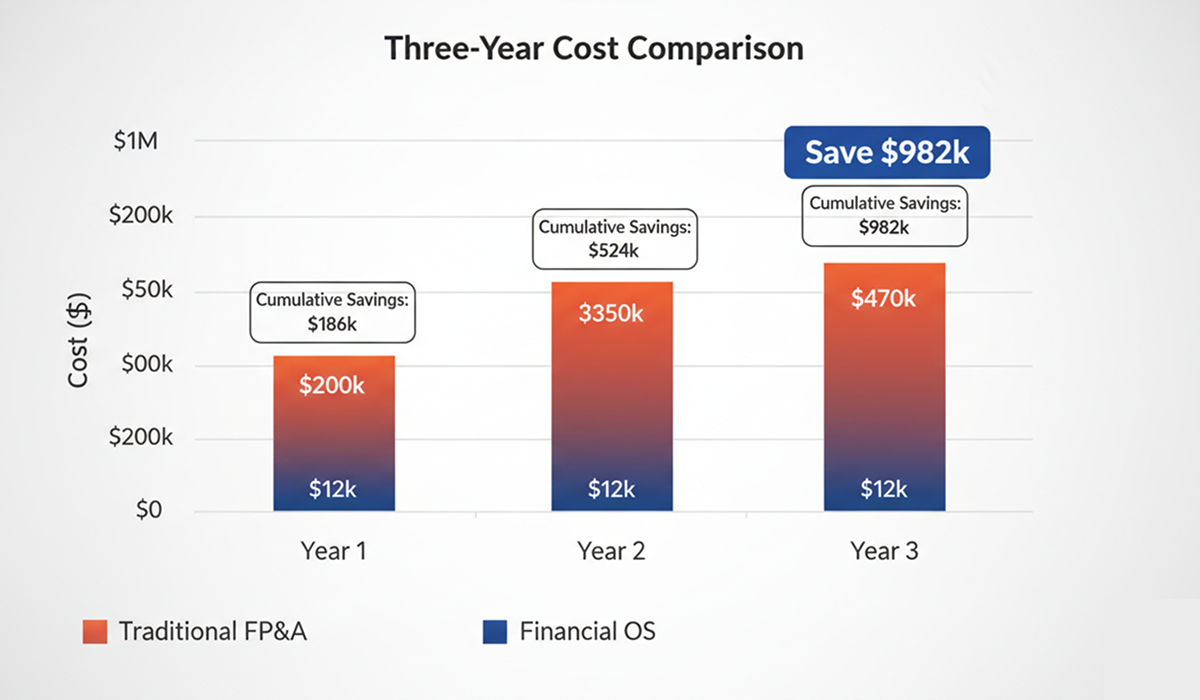
Cost Comparison
| Component | Traditional FP&A | Financial OS |
|---|---|---|
| CFO Salary | $120-200k/year | $0 |
| Analyst(s) | $60-90k each | $0 |
| Software | $5-20k/year | $0-$6k/year |
| Training | $10-20k/year | $0 |
| Overhead | 30% of salaries | $0 |
| Total Year 1 | $200-350k | $0-6k |
| Total Year 3 | $600k-1M+ | $0-18k |
Savings: $582k-$982k over 3 years
Time Comparison
| Task | Traditional FP&A | Financial OS |
|---|---|---|
| Setup | 4-8 weeks | 15 minutes |
| Monthly Close | 5-10 days | Instant |
| Forecast Update | 2-3 days | Real-time |
| Board Report | 3-5 days | 2 clicks |
| Scenario Analysis | 4-8 hours | 2 minutes |
| Ad-Hoc Questions | Hours to days | Instant |
Time Savings: 90-95% reduction
Capability Comparison
| Feature | Traditional FP&A | Financial OS |
|---|---|---|
| Real-Time Data | ❌ Monthly lags | ✅ Always current |
| AI Forecasting | ❌ Manual models | ✅ Machine learning |
| Scenario Planning | ✅ But time-consuming | ✅ Instant |
| Cash Flow Tracking | ✅ Manual process | ✅ Automated |
| Burn Rate Analysis | ✅ Calculated monthly | ✅ Real-time tracking |
| Runway Prediction | ✅ Static calculation | ✅ Dynamic AI prediction |
| Variance Analysis | ✅ But retroactive | ✅ Predictive alerts |
| Board Reporting | ✅ Custom built | ✅ One-click |
| Team Collaboration | ❌ Limited | ✅ Built-in |
| Mobile Access | ❌ Very limited | ✅ Full featured |
Accuracy Comparison
| Metric | Traditional FP&A | Financial OS |
|---|---|---|
| Forecast Accuracy | 65-75% | 85-95% |
| Data Currency | 2-4 weeks lag | Real-time |
| Error Rate | 5-10% (manual) | <1% (automated) |
| Consistency | Varies by person | Always consistent |
When Traditional FP&A Makes Sense
Ideal Scenarios for Traditional FP&A:
-
Large Enterprise ($100M+ revenue)
- Multiple business units
- Complex corporate structure
- Regulatory requirements
- International operations
-
Public Company
- SEC reporting requirements
- Investor relations demands
- Audit complexity
- Compliance needs
-
Heavy M&A Activity
- Frequent acquisitions
- Complex integrations
- Due diligence requirements
- Post-merger consolidation
Warning Signs You DON'T Need Traditional FP&A:
- Pre-Series B startup
- <$10M annual revenue
- <50 employees
- Single product/market
- Limited complexity
- Fast-moving business
Reality: 95% of startups don't need traditional FP&A yet.
When a Financial OS Makes More Sense
Perfect for:
-
Early-Stage Startups (Pre-seed to Series A)
- Need financial discipline
- Can't afford CFO
- Fast-changing business
- Data-driven culture
-
Growth-Stage (Series B-C)
- Scaling rapidly
- Need real-time visibility
- Distributed teams
- Multiple stakeholders
-
Resource-Conscious (Any stage)
- Want to optimize spending
- Prefer automation
- Value speed over tradition
- Embrace modern tools
Specific Use Cases:
Fundraising:
- Build investor-ready models in hours
- Show professional financial discipline
- Answer investor questions instantly
- Demonstrate data-driven approach
Hiring Decisions:
- Model financial impact immediately
- See runway implications
- Test different scenarios
- Make informed decisions
Strategic Planning:
- Explore growth scenarios
- Assess risks quickly
- Optimize resource allocation
- Track progress real-time
The Hybrid Approach: Best of Both Worlds
For Series A+ Startups:
Use Financial OS for:
- Day-to-day operations
- Real-time monitoring
- Team collaboration
- Automated forecasting
- Instant insights
Add Part-Time CFO for:
- Strategic financial advice (2-4 hrs/week)
- Board preparation (monthly)
- Fundraising strategy (quarterly)
- Complex modeling (as needed)
Cost:
- Financial OS: $0-500/month
- Part-time CFO: $2-4k/month
- Total: $24-48k/year vs $200 - 350k/year
Result: 90% of FP&A value at 15% of the cost
Real-World Comparison: Case Studies
Case Study 1: Series A SaaS Company
Company Profile:
- $3M ARR
- 25 employees
- Just raised Series A
- Growing 15% MoM
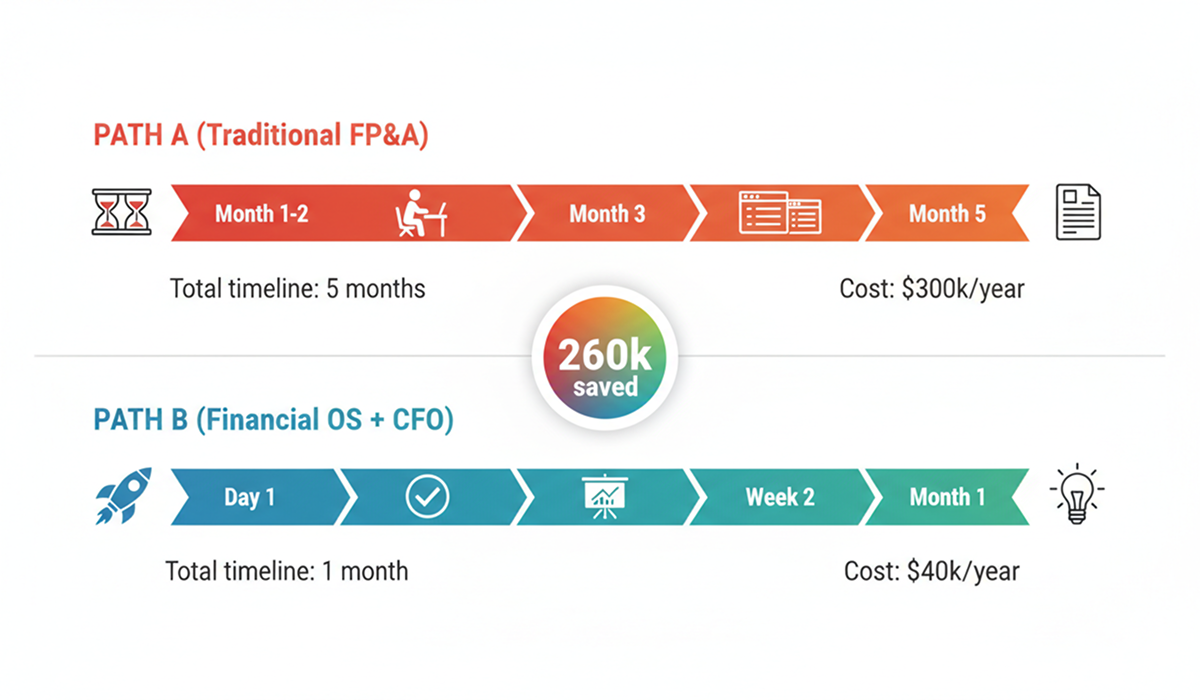
Option A: Traditional FP&A
Hired:
- VP Finance: $160k + equity
- FP&A Analyst: $80k
- Total comp: $240k + benefits
Timeline:
- Month 1-2: Recruiting
- Month 3: Onboarding
- Month 4: Model building
- Month 5: First reports
Results:
- First insights at 5 months
- Monthly reports take 1 week
- Team of 2 fully occupied
- Annual cost: $300k+
Option B: Financial OS + Part-Time CFO
Implemented:
- Uniflow: $300/month
- Fractional CFO: $3k/month (8 hrs)
- Total: $3,300/month
Timeline:
- Day 1: Setup complete
- Week 1: Full operational
- Week 2: Board-ready reports
- Month 1: Strategic CFO advice
Results:
- Instant insights from day 1
- Real-time dashboards
- Strategic CFO guidance
- Annual cost: $40k
Savings: $260k/year (87% reduction)
Case Study 2: Pre-Seed Startup
Company Profile:
- $500k raised
- 5 employees
- 12 months runway
- Technical founder
Option A: Traditional Approach
Reality:
- Can't afford CFO
- Uses spreadsheets
- Spends 15 hrs/month
- Error-prone forecasts
- Missed cash flow crisis
- Ran out of money month 10
Outcome: Shutdown
Option B: Financial OS
Implemented:
- Uniflow Free plan: $0
- Setup time: 20 minutes
- Weekly reviews: 30 min
Results:
- Real-time runway tracking
- AI predicted cash crunch (month 6)
- Adjusted burn rate
- Started fundraising month 8
- Closed seed round month 11
Outcome: Thriving
Feature Deep-Dive: FP&A vs Financial OS
1. Cash Flow Management
Traditional FP&A:
- Monthly cash flow statements
- Manual reconciliation
- Historical analysis
- Static projections
- Reactive alerts
Financial OS:
- Real-time cash position
- Automatic reconciliation
- Predictive analysis
- Dynamic forecasting
- Proactive alerts
Winner: Financial OS ✅
Real-time data prevents cash crises
2. Financial Forecasting
Traditional FP&A:
- Excel-based models
- Manual assumptions
- Monthly updates
- Limited scenarios
- Expert required
Financial OS:
- AI-powered predictions
- Learning algorithms
- Continuous updates
- Unlimited scenarios
- No expertise needed
Winner: Financial OS ✅
AI outperforms manual forecasting by 20-30%
3. Scenario Planning
Traditional FP&A:
- Time-consuming to build
- Limited scenarios (2-3)
- Manual calculations
- Weeks to update
- Expert interpretation
Financial OS:
- Instant scenario creation
- Unlimited possibilities
- Automatic calculations
- Real-time updates
- Plain-English insights
Winner: Financial OS ✅
Speed enables better decision-making
4. Board Reporting
Traditional FP&A:
- Custom PowerPoint decks
- 3-5 days preparation
- Manual data compilation
- Static snapshots
- Professional polish
Financial OS:
- Template-based reports
- One-click generation
- Automatic data sync
- Real-time updates
- Professional design
Winner: Tie ⚖️
FP&A offers more customization, Financial OS offers speed
5. Strategic Advisory
Traditional FP&A:
- Experienced CFO insights
- Industry knowledge
- Strategic recommendations
- Board-level thinking
- Relationship building
Financial OS:
- AI-powered recommendations
- Data-driven insights
- Automated suggestions
- Best practice guidance
- Limited strategic depth
Winner: Traditional FP&A ✅
Human strategic thinking still valuable at scale
6. Cost Efficiency
Traditional FP&A:
- $200-350k/year minimum
- Additional hiring costs
- Training overhead
- Benefits packages
- Office space
Financial OS:
- $0-6k/year
- No hiring costs
- Instant learning
- No benefits needed
- Cloud-based
Winner: Financial OS ✅
97% cost reduction
Migration Strategy: FP&A to Financial OS
For Companies Considering the Switch:
Phase 1: Evaluation (Week 1-2)
- Audit current FP&A costs
- Assess actual value delivered
- Identify redundancies
- Calculate potential savings
Phase 2: Pilot (Week 3-6)
- Implement Financial OS alongside FP&A
- Run parallel processes
- Compare outputs
- Gather team feedback
Phase 3: Transition (Month 2-3)
- Shift daily operations to Financial OS
- Retain FP&A for strategic work
- Reduce FP&A headcount gradually
- Optimize hybrid model
Phase 4: Optimization (Month 4+)
- Full Financial OS adoption
- Part-time CFO for strategy
- Maximize cost savings
- Measure ROI
The Verdict: What's Right for Your Startup?
Choose Traditional FP&A if you:
- ✅ Have $100M+ revenue
- ✅ Are preparing for IPO
- ✅ Have complex entity structures
- ✅ Need deep strategic CFO
- ✅ Have budget for $300k+ annually
Verdict: <5% of startups
Choose Financial OS if you:
- ✅ Have <$50M revenue
- ✅ Are pre-Series C
- ✅ Want to optimize costs
- ✅ Need real-time insights
- ✅ Prefer automation
- ✅ Value speed
- ✅ Have limited finance expertise
Verdict: 95% of startups
Choose Hybrid if you:
- ✅ Have $10-50M revenue
- ✅ Are Series A-B stage
- ✅ Need strategic CFO advice
- ✅ Want operational efficiency
- ✅ Value both speed and depth
Verdict: Growing startups
Future of Startup Finance
The Trend is Clear:
2015-2020: Traditional FP&A dominates
- Hire CFO at Series A
- Build finance team
- Manual processes
2020-2023: Transition begins
- Fractional CFOs emerge
- First Financial OS platforms
- Hybrid models tested
2024-2026: Financial OS standard
- AI becomes table stakes
- Traditional FP&A for enterprise only
- Hybrid model for growth stage
2027+: AI-First Finance
- Autonomous financial management
- CFOs focus purely on strategy
- Real-time everything
Why This Matters:
Startups adopting Financial OS today have:
- Cost advantage: 85-95% savings
- Speed advantage: Real-time vs monthly
- Accuracy advantage: AI vs manual
- Scaling advantage: Automated growth
Early adopters win.
Conclusion: The Right Tool for the Right Stage
Traditional FP&A isn't bad—it's just overkill for most startups.
Think of it like transportation:
- Bicycle (Spreadsheets): Free but slow
- Car (Financial OS): Fast, affordable, efficient
- Private Jet (Traditional FP&A): Expensive, overkill for most
For 95% of startups, a Financial OS is the perfect vehicle.
You get:
- ✅ 90% of FP&A capabilities
- ✅ 5% of FP&A cost
- ✅ 10x FP&A speed
- ✅ Better accuracy
- ✅ Easier to use
When you need traditional FP&A ($100M+ revenue), you'll know—and can afford it.
Until then: Financial OS + part-time CFO = optimal setup.
Ready to modernize your startup finance? Try Uniflow's free AI-powered financial operating system. Get FP&A-level insights without the FP&A price tag.
Related Articles
- Financial Operating System 101: Complete Guide
- How AI Improves Financial Forecasting
- Uniflow vs Spreadsheets: Why Make the Switch
- Why Founders Fail at Financial Planning
Frequently Asked Questions
Q: Will a Financial OS replace my CFO?
A: No. It replaces manual FP&A work, freeing CFOs for strategic work. Think "CFO + Financial OS" not "CFO vs Financial OS."
Q: At what revenue should I hire a full-time CFO?
A: Generally $10-15M ARR for part-time, $25-50M ARR for full-time. But many companies delay longer with Financial OS + fractional support.
Q: Can Financial OS handle complex revenue models?
A: Yes. Modern Financial OS platforms handle subscription, usage-based, multi-currency, and complex revenue recognition.
Q: What about audit and compliance?
A: Financial OS provides audit trails and compliance reporting. For IPO-level requirements, add traditional FP&A support.
Q: How accurate is AI forecasting vs experienced CFO?
A: AI forecasting (85-95% accuracy) typically beats manual models (65-75%). But experienced CFOs add strategic context AI can't.
Q: Can I use both Financial OS and traditional FP&A?
A: Yes! Hybrid model is optimal for growth-stage: Financial OS for operations, strategic CFO for advisory.
Q: What if my investors expect traditional FP&A?
A: Modern investors prefer data-driven startups using best-in-class tools. Financial OS impresses investors more than traditional approaches.
Q: When should I transition from Financial OS to traditional FP&A?
A: When complexity justifies the cost—typically late Series C, pre-IPO, or $100M+ revenue. Most never need to.
Keywords: financial operating system vs FP&A, traditional FP&A, financial planning and analysis, financial OS for startups, CFO vs financial OS, startup financial management, FP&A alternative
About the Author: