

Financial OS vs Traditional FP&A for Startups: Which Model Is Right?
A financial operating system vs traditional FP&A comparison is a choice between software-led financial operations and a people-led finance function. A financial OS connects data, automates recurring analysis, and improves visibility into cash and performance. Traditional financial planning and analysis (FP&A) provides judgment, planning discipline, governance, and strategic advice. Most startups eventually need both, but they rarely need both at full scale from day one.
“The most effective finance system is not the one with the most reports. It is the one that helps the company make better decisions sooner.” — Michael Stan, accountant, financial advisor, and founder of Uniflow
What is the difference between a financial OS and traditional FP&A?
A financial operating system is a technology layer for collecting, organizing, monitoring, and analyzing financial and operating data. Traditional FP&A is a finance discipline performed by people who budget, forecast, explain variances, and advise leadership. A financial OS can automate parts of FP&A, but it does not replace accounting controls, executive judgment, tax expertise, or CFO accountability.
| Dimension | Financial operating system | Traditional FP&A |
|---|---|---|
| Primary model | Software-led financial operations | People-led finance function |
| Data cadence | Continuous or scheduled, depending on integrations | Monthly, quarterly, or event-driven |
| Core tools | Connected data, dashboards, workflows, and AI-assisted analysis | Spreadsheets, accounting software, BI, planning models, and presentations |
| Best at | Speed, repeatability, visibility, and routine analysis | Complex judgment, governance, planning, and stakeholder management |
| Main limitation | Depends on accurate source data and human oversight | Can be expensive and slow to build |
The practical distinction is simple: a financial OS helps a lean team operate finance consistently, while FP&A helps leadership interpret financial information and make complex decisions.
Why does startup finance need a different operating model?
Startups make high-consequence decisions with limited historical data, small teams, and rapidly changing assumptions. A delayed cash view can affect hiring, fundraising, pricing, and vendor commitments. The Federal Reserve’s 2024 Report on Employer Firms identifies uneven cash flow and access to capital as continuing challenges for small businesses.
For a founder or CFO, the most important questions are operational:
- How many months of runway remain?
- Which expenses are increasing fastest?
- Can the company afford the next hire?
- What happens if sales growth is slower than expected?
- Which revenue, churn, and hiring assumptions drive the forecast?
- When should the company begin fundraising?
- How much cash is committed but not yet spent?
Traditional FP&A can answer these questions well. The challenge is that building a complete FP&A process may require more staff, time, and specialist expertise than an early-stage company can justify.
What is traditional FP&A?
Traditional FP&A is the finance discipline responsible for budgeting, forecasting, management reporting, variance analysis, scenario planning, and decision support. In a larger organization, the function may include a CFO, finance manager, FP&A analysts, accounting partners, and business-unit leaders operating within a formal monthly or quarterly planning cycle.
FP&A is not the same as bookkeeping. Bookkeeping records and organizes transactions; FP&A uses financial and operating information to explain performance and plan what happens next. Strong FP&A depends on reliable accounting data, but its main purpose is decision support.
How does the traditional FP&A process work?
Traditional FP&A usually begins after accounting close. Finance gathers data, reconciles it, updates the model, explains variances, prepares reports, and discusses actions with leadership. The exact timeline varies, but analysis often starts after the period has ended and conditions may already have changed.
| Process stage | Typical activity | Common bottleneck |
|---|---|---|
| Close and data collection | Gather accounting, banking, payroll, billing, and CRM data | Manual exports and inconsistent definitions |
| Reconciliation | Match transactions and investigate differences | Unclear ownership and manual review |
| Model update | Refresh assumptions, formulas, and forecast periods | Broken links or outdated inputs |
| Variance analysis | Compare actuals with budget or forecast | Explanations arrive after decisions are made |
| Reporting | Prepare management or board materials | Reformatting and version-control issues |
| Review and action | Discuss risks and approve changes | Meeting cadence limits responsiveness |
The Association for Financial Professionals’ FP&A resources describe FP&A as an increasingly data-driven function focused on planning, analysis, and decision support. In practice, the more time a team spends preparing data, the less time it has to interpret results and advise the business.
What is a financial operating system?
A financial operating system is software that connects financial data, operating assumptions, workflows, dashboards, and analysis in one environment. Depending on the product, it may integrate with banks, accounting platforms, payroll, billing, expense management, and customer systems through native connections or APIs.
A financial OS can help a startup:
- Consolidate data from approved systems
- Monitor cash balance, burn, and runway
- Refresh forecasts when actual results change
- Compare hiring, pricing, and growth scenarios
- Surface unusual spending or performance changes
- Create a shared view for founders, finance leaders, and investors
- Reduce repetitive spreadsheet and reporting work
A financial OS does not make source data accurate automatically. Bank feeds, accounting classifications, revenue definitions, and payroll records still require controls, reconciliation, and review.
How does a financial operating system process data?
A financial OS generally follows a recurring operating loop: connect data, normalize it, apply business rules, calculate metrics, identify changes, and support action. The cadence depends on the source. Bank transactions may refresh frequently, while accounting close, revenue recognition, and payroll may remain periodic.
| Process stage | Financial OS approach | Control required |
|---|---|---|
| Data connection | Pull data from approved financial and operating systems | Confirm permissions and integration status |
| Normalization | Map accounts, categories, entities, and metrics | Maintain controlled definitions |
| Monitoring | Update cash, burn, runway, and operating indicators | Review data freshness and exceptions |
| Forecasting | Apply assumptions to actuals and projected activity | Document ownership and assumptions |
| Scenario planning | Test hiring, pricing, growth, and spending changes | Validate model logic |
| Reporting | Share dashboards and recurring outputs | Review before external distribution |
The system improves speed and consistency only when the company defines its metrics clearly and assigns responsibility for reviewing the output.
How do financial OS and traditional FP&A compare?
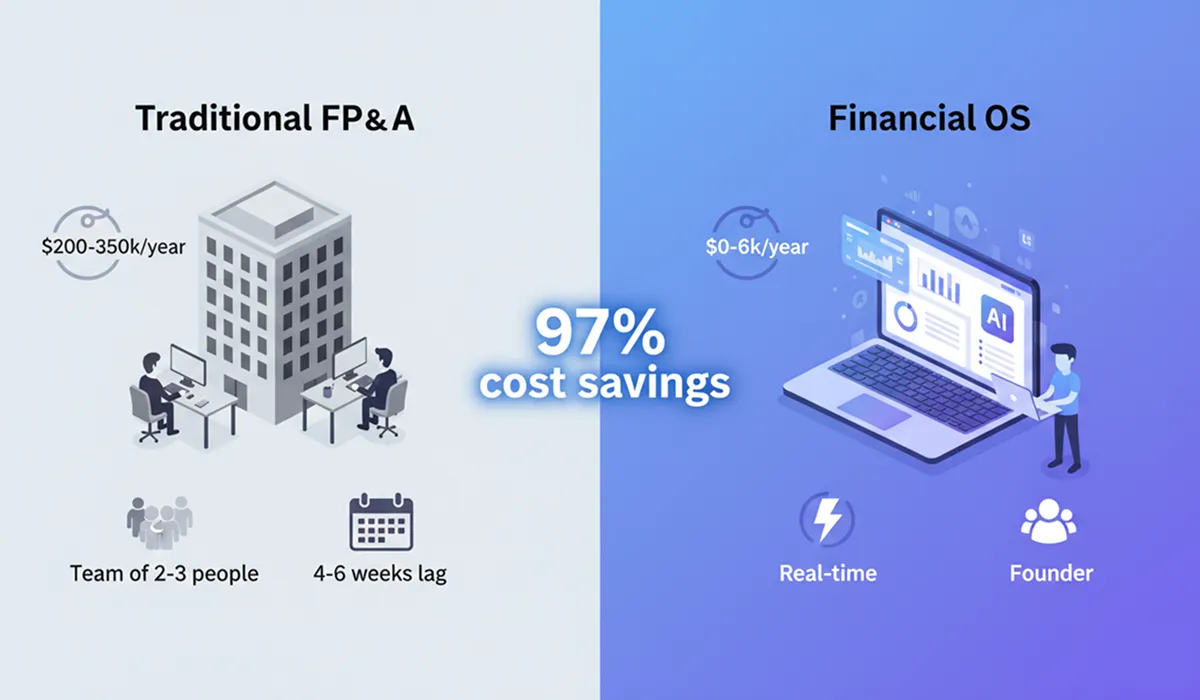
A financial OS generally performs better on speed, repeatability, and the cost of routine analysis. Traditional FP&A performs better when a company needs complex judgment, formal controls, stakeholder management, or detailed planning across entities and business units. For many startups, the strongest model is a financial OS for recurring operations supported by accounting and CFO-level review.
| Decision factor | Financial OS | Traditional FP&A |
|---|---|---|
| Reporting speed | Fast when integrations and mappings are reliable | Depends on the finance team’s close and reporting process |
| Routine analysis | Highly repeatable and partially automated | Often requires recurring spreadsheet or BI work |
| Strategic judgment | Limited by system context and human review | Strong when experienced finance leaders are involved |
| Initial cost | Usually subscription, setup, and support costs | Usually staffing, software, and process-design costs |
| Scalability | Efficient for recurring workflows | Strong for organizational and analytical complexity |
| Controls | Depends on permissions, source systems, and review procedures | Can be formalized through finance policies and ownership |
| Best use | Lean startup finance operations | Complex planning and strategic finance |
What is the cost difference between a financial OS and FP&A?
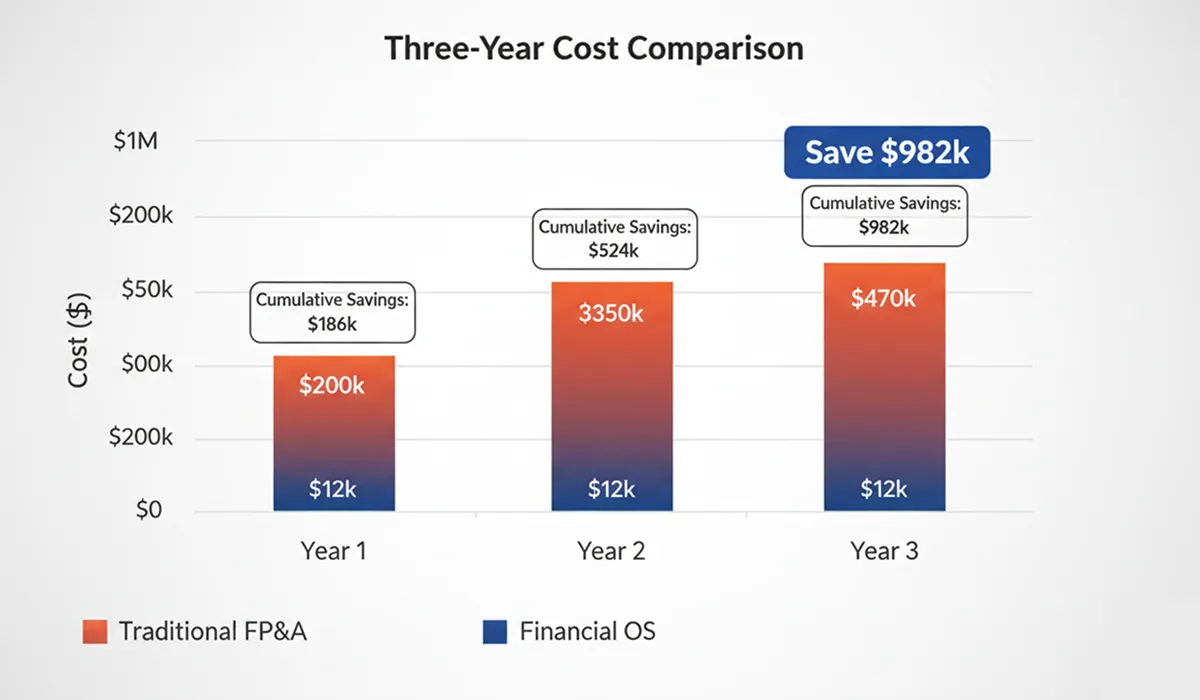
The cost difference depends on what “traditional FP&A” means. An internal finance team carries salary, benefits, recruiting, equity, management overhead, and software costs. An outsourced or fractional model has a different cost structure. A financial OS usually has subscription, integration, implementation, and advisory costs rather than full-time staffing costs.
| Cost component | Financial operating system | Traditional FP&A |
|---|---|---|
| Finance leadership | Usually not required for basic software use | Salary, benefits, recruiting, and potentially equity |
| Analysts | Routine reporting may be automated | Additional cost as reporting complexity grows |
| Software | Subscription and integration costs | Accounting, planning, BI, and reporting tools may be separate |
| Implementation | Configuration, data connection, and validation | Hiring, process design, model creation, and training |
| Advisory | Can be added through an accountant or fractional CFO | May be included in the finance team or outsourced model |
| Pricing basis | Vendor-specific subscription; verify current quote | Company-specific staffing or service quote |
The U.S. Bureau of Labor Statistics publishes compensation information for financial managers, but the total cost of a startup CFO varies by location, seniority, benefits, equity, and scope. A salary benchmark should not be treated as a universal FP&A price.
For planning purposes, compare the total cost of each operating model:
Total finance cost = software + implementation + accounting support + advisory support + internal finance labor
How should a startup calculate the ROI of a financial OS?
A startup should calculate ROI using measurable time savings, avoided hiring or consulting costs, earlier decisions, and improved reporting reliability. Software is not automatically valuable because it has more features. Value appears when the underlying data is reliable, the team uses the system consistently, and decisions improve as a result.
Use this calculation:
Annual benefit = hours eliminated × loaded hourly cost + avoided hiring or consulting cost + value of earlier decisions − annual software and implementation cost
Track a baseline before purchasing:
- Hours spent collecting and cleaning data each month
- Time required to update the forecast
- Number of recurring reports
- Frequency of unexplained variances
- Time required to answer investor and board questions
- Decisions delayed because information was unavailable
For example, if a team spends 20 hours per month on recurring reporting at a loaded cost of $75 per hour, the direct annual labor opportunity is $18,000. That excludes the potential value of detecting a cash or hiring problem earlier.
How much faster is a financial OS than traditional FP&A?
A financial OS can shorten recurring reporting and forecast-refresh work, but it does not eliminate accounting close, transaction review, or management judgment. A simple startup may configure core integrations quickly. A multi-entity company with poor categorization or incomplete historical data may need weeks of mapping and validation.
| Task | Financial operating system | Traditional FP&A |
|---|---|---|
| Initial setup | Core integrations can be configured quickly | Hiring and process design may take weeks or months |
| Monthly reporting | Automated refresh followed by human review | Data gathering, reconciliation, and presentation preparation |
| Forecast update | Actuals and assumptions refresh in a connected model | Model owner updates assumptions and formulas |
| Scenario analysis | Reusable scenarios can be tested quickly | Often requires spreadsheet work |
| Board reporting | Dashboards and templates reduce preparation | Manual compilation and narrative preparation |
| Ad hoc questions | Faster self-service access when data is connected | Depends on finance-team availability |
Implementation speed is not the same as decision-readiness. A startup should not trust outputs until balances, classifications, and key metrics reconcile to the accounting source.
How long does FP&A software implementation take?
FP&A software implementation can take a day for a simple company with clean data and several weeks for a company with multiple entities, complex mappings, or incomplete records. Integration is only the first milestone. The startup must validate historical data, metric definitions, permissions, and forecast logic before using outputs for board or investor reporting.
Before selecting a platform, ask:
- Which systems connect natively?
- How frequently does each connection refresh?
- How far back can historical data be imported?
- Who owns account and metric mapping?
- Can assumptions be versioned and approved?
- Can the company export its data and reports?
- What controls exist for investor and board reporting?
Which capabilities matter most to startup finance teams?
The most valuable capabilities are those that improve decisions without weakening controls. A dashboard is useful only when its metrics have clear definitions. An AI-generated forecast is useful only when assumptions, source data, and limitations are visible. Startups should evaluate operational usefulness rather than feature count.
| Capability | Financial operating system | Traditional FP&A |
|---|---|---|
| Cash monitoring | Connected monitoring with scheduled refreshes | Periodic reporting and reconciliation |
| Burn-rate analysis | Automated calculation from categorized data | Usually model- or report-driven |
| Runway planning | Recalculated as inputs change | Updated when the model is refreshed |
| Scenario planning | Faster reusable scenarios with review | Flexible but often labor-intensive |
| Variance analysis | Faster alerts and drill-downs | Detailed and explainable when well staffed |
| Board reporting | Faster standardized dashboards and outputs | Highly customizable |
| Strategic advice | Limited by context and governance | Strong when experienced leaders are involved |
| Audit and controls | Depends on permissions and audit trails | Can be formalized across a finance function |
| Self-service access | Commonly available through cloud software | Varies by tool and team |
How accurate is AI forecasting compared with FP&A?
There is no universal accuracy percentage for AI forecasting or traditional FP&A. Accuracy depends on the forecast horizon, business volatility, data quality, revenue concentration, seasonality, and the definition of “accurate.” AI can reduce calculation and refresh errors, but it cannot reliably predict an unannounced customer loss or correct an incorrectly categorized transaction without suitable data.
The U.S. Government Accountability Office’s AI resources emphasize reliability, transparency, and accountability in AI systems. Those principles apply directly to financial forecasting.
Measure forecast quality consistently:
- Define the horizon, such as 30, 60, or 90 days.
- Compare forecasted and actual cash, revenue, and expenses.
- Use mean absolute percentage error where appropriate.
- Separate data errors from assumption errors.
- Record when assumptions changed and why.
- Review whether the forecast improved a decision, not only whether it matched the outcome.
A forecast that is directionally useful and updated quickly may be more valuable than a highly detailed forecast that arrives after the decision window has closed. Human review remains necessary for unusual events, strategic changes, and material decisions.
When does traditional FP&A make sense for a startup?
Traditional FP&A makes sense when complexity, stakeholder requirements, or decision risk justify dedicated finance capacity. This is more common in companies with multiple entities, international operations, complex revenue recognition, significant debt, frequent acquisitions, public-company reporting requirements, or large operating budgets. Revenue alone should not determine the answer; complexity and governance matter just as much.
Which startups are most likely to need traditional FP&A?
A startup should consider a dedicated FP&A function when several of these conditions apply:
- Multiple legal entities or business units
- Complex intercompany transactions
- International tax, currency, or regulatory requirements
- Detailed headcount and capacity planning
- Material annual budgeting processes
- Frequent acquisitions or integration work
- Formal lender, board, or investor reporting requirements
- A finance team large enough to support specialized roles
- Industry-specific forecasting requirements
- Significant debt or capital allocation decisions
Traditional FP&A may also be appropriate early for a capital-intensive, regulated, or operationally complex company. A startup can need senior financial judgment before it needs a large team of analysts.
When does a financial OS make more sense?
A financial OS is usually a strong fit when a startup needs reliable visibility but does not yet need a large finance department. This often includes solo founders, pre-seed through Series B teams, and companies with a bookkeeper or accountant but no full-time FP&A staff. The goal is not to remove financial discipline; it is to make that discipline easier to maintain.
Who benefits most from a financial OS?
A financial OS is particularly useful for companies that:
- Need a current view of cash and runway
- Pull data from several systems
- Spend too much time maintaining spreadsheets
- Need repeatable investor or board reporting
- Make frequent hiring or spending decisions
- Want founders and operators to self-serve basic answers
- Need to preserve a financial history as the company grows
- Prefer to add finance expertise gradually
Solo founders usually benefit from a simple operating rhythm: review cash weekly, update assumptions when conditions change, and escalate accounting, tax, and legal questions to qualified professionals.
What are practical financial OS use cases?
Cash management: Monitor balances, committed spending, burn, and runway before approving new expenses.
Hiring: Model compensation, benefits, start dates, and the effect of each role on runway.
Fundraising: Prepare a consistent view of historical performance, use of funds, forecast assumptions, and financing scenarios.
Pricing and growth planning: Test the cash effect of conversion, churn, acquisition cost, and hiring assumptions.
Board reporting: Reduce recurring data preparation while preserving a clear narrative about results, risks, and decisions.
Operating reviews: Give leadership one shared set of definitions for revenue, expenses, burn, and key performance indicators.
What is the best hybrid model for a startup?
The hybrid model combines automated financial operations with human accounting and strategic review. The financial OS handles connected data, recurring calculations, monitoring, and first-pass analysis. An accountant or controller protects the books and close process. A fractional or full-time CFO provides judgment on capital allocation, fundraising, pricing, hiring, and board communication.
| Responsibility | Financial OS | Accountant or controller | CFO or fractional CFO |
|---|---|---|---|
| Data aggregation | Primary | Review | Oversight |
| Bookkeeping and close | Support | Primary | Review |
| Cash and runway monitoring | Primary | Review | Decision support |
| Forecast assumptions | Calculate and compare | Validate inputs | Own strategic assumptions |
| Scenario analysis | Accelerate | Check logic | Interpret trade-offs |
| Tax and compliance | Not a substitute | Primary with specialists | Oversight |
| Fundraising strategy | Provide evidence | Prepare support | Primary adviser |
| Board narrative | Supply metrics | Validate figures | Primary owner |
This structure avoids two common mistakes: asking software to replace professional judgment, or paying senior finance professionals to perform routine data preparation that software can automate.
Why do manual FP&A processes persist?
Manual FP&A persists because spreadsheets are familiar, flexible, and inexpensive to start. They become harder to govern as systems and stakeholders multiply. The AICPA & CIMA finance function resources describe finance as increasingly focused on technology, data, and decision support, but automation does not remove the need for ownership and controls.
To reduce manual work:
- Establish a source of truth for each data type.
- Define ARR, gross margin, burn, runway, and other key metrics.
- Standardize account and department mappings.
- Automate recurring imports and calculations.
- Reconcile exceptions instead of rechecking every transaction manually.
- Document forecast assumptions and approval owners.
- Review outputs on a fixed weekly or monthly cadence.
How should a startup migrate from spreadsheets or FP&A tools?
Migration should begin with the decisions the company needs to improve, not with an attempt to automate every finance process. Connect the minimum data required to support those decisions, run the new workflow alongside the current process for one or two reporting cycles, and investigate differences before retiring the old model.
What are the steps for moving to a financial operating system?
Phase 1: Define the operating questions
Document the metrics and decisions that matter: cash position, runway, burn, revenue, gross margin, hiring capacity, and fundraising timing.
Phase 2: Audit the data
Review accounting categories, bank connections, billing records, payroll data, historical periods, and unresolved reconciliation issues.
Phase 3: Connect and map
Connect approved systems, map accounts and metrics, and establish permissions. Do not treat an integration as validated until totals reconcile to the accounting source.
Phase 4: Run in parallel
Compare cash, revenue, expense, and runway outputs with the existing model. Investigate differences instead of forcing the systems to match.
Phase 5: Establish a review cadence
Assign owners for data quality, forecast assumptions, and decision reviews. A weekly cash review and monthly close review are practical starting points.
Phase 6: Retire redundant work
Once outputs are trusted, remove duplicate spreadsheet steps. Preserve only the models needed for specialized analysis, audit support, or scenario work.
How does Uniflow fit into the financial OS versus FP&A comparison?
Uniflow is a financial operating system for startups that brings financial data and operating analysis into a single workflow. It is designed to help founders and finance teams monitor cash, understand runway, review performance, and test decisions without building every recurring report manually. Uniflow complements accounting and professional finance support rather than replacing them.
| Compared entity | Best fit | Primary value | Important limitation |
|---|---|---|---|
| Uniflow | Solo founders and startup finance teams that need connected financial visibility | Automated financial monitoring, forecasting support, and decision-ready views | Output quality depends on connected data, configuration, and human review |
| Traditional FP&A team | Larger or more complex organizations | Deep analysis, governance, planning, and strategic partnership | Higher staffing cost and slower process setup |
| Spreadsheet-led finance | Very early companies with simple operations | Flexibility and low initial cost | Version-control, manual-update, and error risks increase with complexity |
| Fractional CFO alone | Startups needing strategic guidance without a full-time executive | Judgment, fundraising support, and financial leadership | Repetitive data preparation may remain manual without an operating system |
The original examples modeled Uniflow at $300 per month for a Series A scenario and a free plan for a pre-seed scenario. Pricing, plan availability, integrations, and limits can change. Confirm current terms directly before making a purchasing decision.
What does a realistic startup implementation look like?
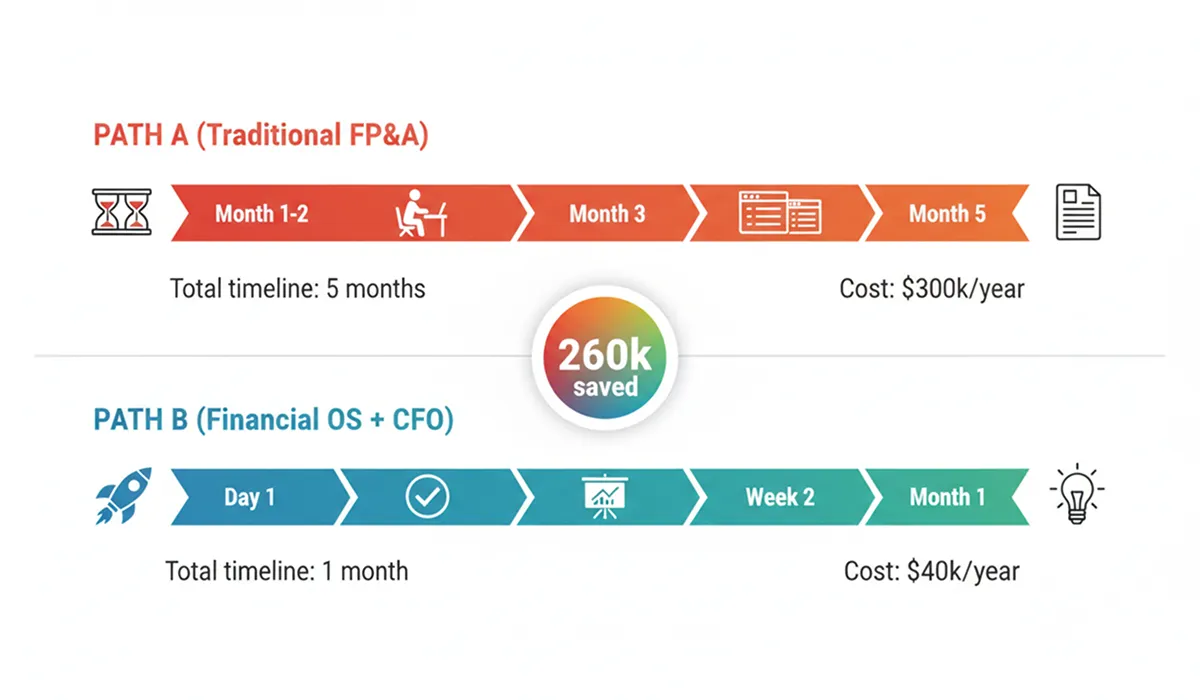
A realistic implementation begins with a narrow operating scope instead of attempting to automate every finance process at once. A startup might first connect accounting, banking, payroll, and billing systems; validate cash and expense reporting; and then add forecasting and scenario planning after the underlying data is trusted.
How could a Series A SaaS company structure the decision?
Consider a hypothetical SaaS company with $3 million in ARR, 25 employees, and a newly raised Series A round. It may need board reporting, hiring plans, runway analysis, and a more reliable forecast, but not necessarily a full VP Finance and FP&A analyst on day one.
Traditional staffing path:
- Recruit and hire finance leadership
- Build the chart of accounts and reporting model
- Create a recurring close and forecast process
- Add analyst capacity as reporting requirements grow
- Carry salary, benefits, recruiting, and management costs
Financial OS plus advisory path:
- Connect accounting, banking, payroll, and billing data
- Validate reporting categories and historical totals
- Use software for recurring monitoring and scenario work
- Add an accountant or fractional CFO for close, strategy, and board review
- Expand the finance team when complexity requires it
The correct comparison is not “software versus a CFO.” It is the cost, speed, and control profile of different combinations of software, accounting, and financial expertise.
What should founders evaluate before choosing a financial tool?
Founders should evaluate whether a product improves the company’s financial operating rhythm, not whether it has the longest feature list. A strong evaluation covers data coverage, metric definitions, forecast transparency, permissions, exportability, support, security practices, and total cost. The product should improve visibility without creating unsupported confidence in automated outputs.
Which questions should a CFO or founder ask vendors?
- Which financial and operating systems can the product connect to?
- How frequently does each integration refresh?
- Can users inspect source transactions behind a metric?
- How are account mappings and business rules maintained?
- Can assumptions be changed, versioned, and audited?
- What happens when data is missing or stale?
- Can the product support multiple entities and currencies?
- What permissions exist for founders, operators, accountants, and investors?
- Can reports and raw data be exported?
- What implementation and support services are included?
- How is customer financial data protected?
- What is the full annual cost at the company’s expected growth?
What is the best model by startup stage?
Stage-based recommendations are a useful starting point, but complexity and governance matter more than a funding label. A regulated pre-seed company may need specialist finance support earlier than a simple SaaS company with higher revenue. A fast-growing startup may need a controller before it needs a large FP&A team.
| Startup situation | Recommended starting model |
|---|---|
| Solo founder with simple transactions | Financial OS plus bookkeeping support |
| Pre-seed or seed company | Financial OS, accountant, and periodic financial review |
| Series A company adding employees and investors | Financial OS plus controller or fractional CFO |
| Series B or C company with growing complexity | Financial OS plus dedicated finance leadership |
| Multi-entity, international, regulated, or acquisition-heavy company | Dedicated finance team and formal FP&A supported by software |
| Public-company or pre-IPO environment | Formal controls, specialized finance leadership, and enterprise planning processes |
What is the final verdict on financial OS vs traditional FP&A?
For most early-stage startups, a financial operating system is a practical first layer for cash visibility, forecasting support, and repeatable financial operations. Traditional FP&A becomes more valuable as complexity, governance, and strategic planning requirements increase. The durable approach is progressive: automate routine work first, add accounting controls next, and add senior finance judgment as the business can use it.
Choose a financial OS when you need:
- Current cash and runway visibility
- Faster recurring reporting
- Less spreadsheet maintenance
- Repeatable scenarios and forecasts
- A shared financial view for a small team
- Lower initial cost than building a finance department
Choose traditional FP&A when you need:
- Complex planning across entities or business units
- Formal governance and reporting requirements
- Detailed strategic analysis
- Significant transaction, debt, or M&A support
- A dedicated finance partner for leadership
For many startups, the most effective operating model is financial OS plus accounting support plus fractional CFO guidance. This combination preserves human judgment while reducing the manual work that makes early-stage finance slow and fragile.
Is Uniflow worth evaluating for startup finance?
Uniflow is worth evaluating if your startup needs a connected view of cash, runway, performance, and scenarios but is not ready to build a large FP&A function. Start with a focused pilot: connect the systems containing core financial data, reconcile outputs to the books, and measure whether the platform reduces reporting effort or improves decisions.
Explore Uniflow’s financial operating system for startups.
What are the frequently asked questions about financial OS and FP&A?
Does a financial operating system replace a CFO?
No. A financial operating system can reduce manual data collection, reporting, and routine analysis, but it cannot replace a CFO’s accountability, judgment, fundraising strategy, stakeholder management, or business context. The most effective model is often CFO or fractional CFO oversight supported by reliable, automated financial operations.
When should a startup hire a full-time CFO?
There is no universal revenue threshold. A startup should consider a full-time CFO when financial complexity, financing activity, governance needs, or strategic decision volume requires dedicated leadership. Hiring should follow operational needs rather than a fixed ARR milestone. A fractional CFO may be appropriate during the transition.
Can a financial operating system handle complex revenue models?
It depends on the product and configuration. Subscription, usage-based, multi-currency, deferred-revenue, and other complex models may require specialized accounting and revenue-recognition systems. A financial OS can provide planning and operating visibility, but it should not replace technical accounting, audit, or tax expertise.
Is a financial OS suitable for a solo founder?
Yes. It can provide a repeatable view of cash, runway, spending, and hiring capacity without requiring the founder to become a spreadsheet administrator. A solo founder should still use qualified bookkeeping, tax, and accounting support where required. Automation improves visibility; it does not transfer legal or financial responsibility away from the company.
Can a startup use both FP&A and a financial OS?
Yes. A hybrid model is often the most practical approach. The financial OS can manage connected data, recurring metrics, alerts, and scenarios, while FP&A or a CFO handles assumptions, strategic recommendations, board communication, and complex analysis.
How should a startup validate AI-generated forecasts?
Compare forecasts with actual cash, revenue, and expenses over a defined horizon. Review assumptions, data freshness, categorization, and confidence limits behind each output. Track forecast error over time and document material changes. AI-generated analysis should support a review process rather than bypass it.
What should investors expect from a startup’s finance function?
Investors generally need timely, consistent, and explainable information about performance, cash use, runway, risks, and assumptions. They do not necessarily require a specific software category. Accurate books, clear metric definitions, repeatable reporting, and credible forecasts matter more than the appearance of a large finance department.
When should a startup move from a financial OS to traditional FP&A?
A startup should move toward formal FP&A when complexity or reporting obligations exceed what a lean operating model can support. Signals include multiple entities, frequent acquisitions, international operations, detailed departmental planning, material debt, public-market preparation, or a sustained need for specialized financial analysis. The transition can be gradual.
Which related articles should you read next?
- Financial Operating System 101: Complete Guide
- How AI Improves Financial Forecasting
- Uniflow vs Spreadsheets: Why Make the Switch
- Why Founders Fail at Financial Planning
Keywords: financial operating system vs FP&A, traditional FP&A, financial planning and analysis, financial OS for startups, CFO vs financial OS, startup financial management, FP&A alternative
About the Author: Michael Stan is an accountant, financial advisor, and founder of Uniflow. He has spent more than a decade advising early-stage startups and building financial systems for better planning, cash visibility, and operating decisions.